The Night the Yellow Planes Went Dark
At 3:00 AM Eastern time on May 2, 2026, the Association of Flight Attendants sent a message to its Spirit Airlines members. It read: “We are delivering the hardest news of our lives. Spirit will cease operations.”
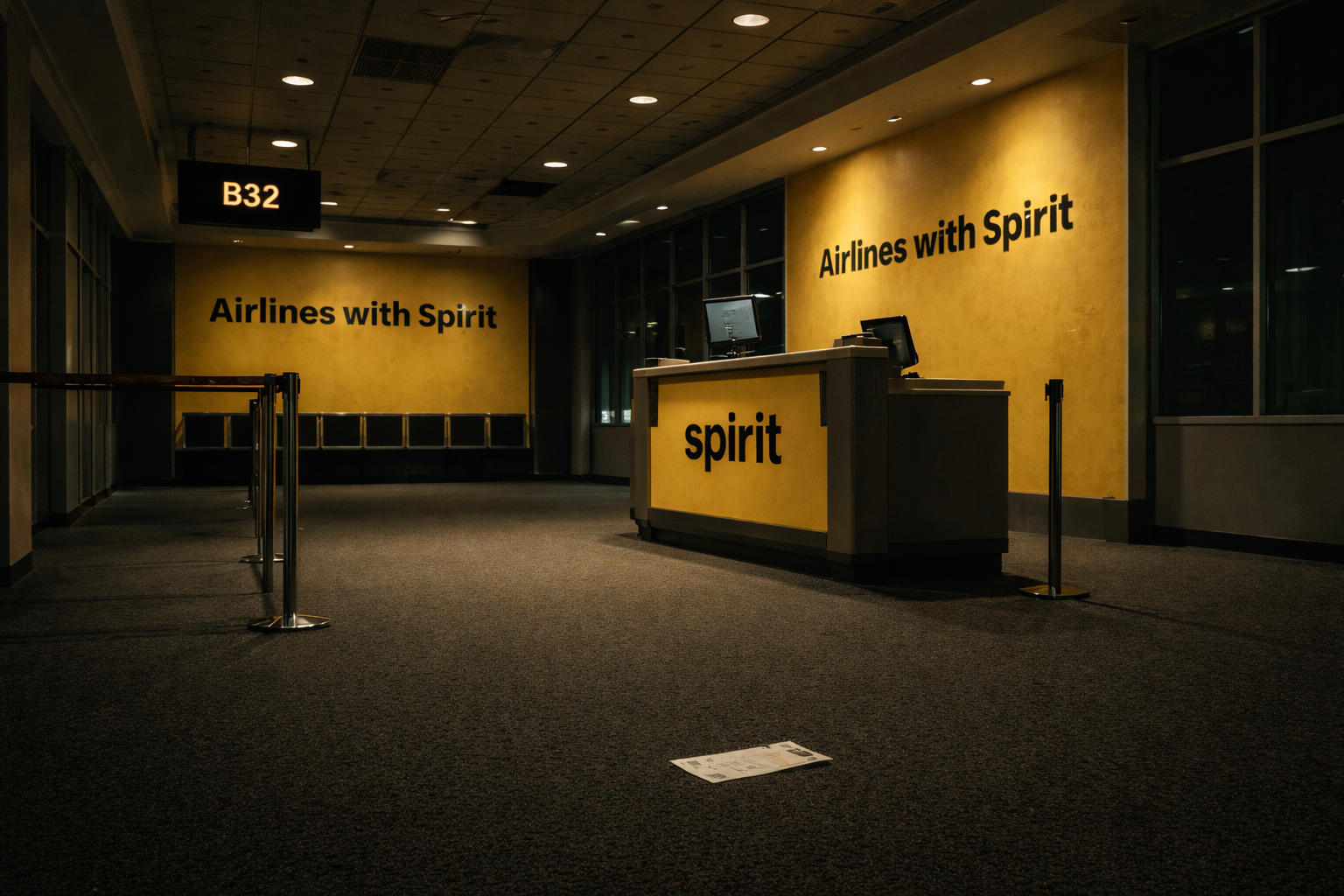
By the time most of America woke up, the airline was already gone. Thirty-four years of service. Seventeen thousand jobs. Hundreds of bright yellow planes — all grounded overnight. Airport kiosks went dark. Customer service lines went silent. And a message appeared at Spirit terminals across the country: “All flights have been canceled, and customer service is no longer available.”
It was the first collapse of a major U.S. airline since Midway Airlines folded in the immediate aftermath of September 11, 2001. And for the millions of budget travelers who had relied on Spirit as the only airline that made flying financially possible, it felt like the end of an era.
But this collapse did not happen overnight — even though it ended that way. The story of Spirit Airlines is one of the most dramatic in American aviation history, spanning four years of mounting losses, two bankruptcies, a blocked merger, a desperate government bailout bid, and a final fuel price shock that made survival mathematically impossible.
Here is the full story.
Phase 1: The Seeds of Collapse (2020–2022)
Spirit Airlines had once been one of the most profitable carriers in the United States. Its ultra-low-cost model — strip out every amenity, charge separately for everything from carry-on bags to seat selection, fill every plane to capacity — generated strong returns during the years of cheap fuel and stable demand.
Then the pandemic hit.
Between 2020 and 2024, Spirit lost more than $2.5 billion. The airline that had been built on full planes and wafer-thin margins suddenly faced a world where planes were flying half-empty and passengers were terrified to travel. Spirit bled cash at a rate that would prove impossible to fully recover from.
In February 2022, a potential lifeline appeared. Frontier Airlines announced plans to acquire Spirit in a deal that would have created the fifth-largest carrier in the United States, valued at $6.6 billion. It seemed like an elegant solution — two ultra-low-cost carriers combining to create a competitor large enough to take on the legacy airlines.
It did not work out that way.
Phase 2: The Merger That Never Was (2022–2024)
While Spirit was negotiating with Frontier, JetBlue swooped in with a rival bid — and a much higher price. The bidding war was good news for Spirit shareholders, but it ultimately led the airline into a regulatory trap.
JetBlue’s proposed acquisition was blocked by a federal court on antitrust grounds in January 2024. The judge ruled that a JetBlue-Spirit merger would harm competition by eliminating one of the few ultra-low-cost options available to budget-conscious travelers. The ruling, intended to protect passengers from higher fares, ultimately contributed to the destruction of the very airline it was meant to protect.
With the JetBlue merger dead and no other suitors, Spirit was left facing its mounting debt alone.
Phase 3: First Bankruptcy (November 2024 – March 2025)
Spirit Airlines filed for Chapter 11 bankruptcy protection on November 18, 2024. The airline had accumulated over $3.3 billion in long-term debt, reporting net losses of $554 million in 2022 and $447 million in 2023 alone.
The Chapter 11 process was designed to give Spirit breathing room — to restructure its debts, renegotiate contracts, and emerge as a leaner, more viable carrier. And initially, it seemed to work. Spirit emerged from its first bankruptcy in March 2025, with a restructuring plan that reduced its debt substantially and cut its fleet from 214 to 94 aircraft.
But the underlying business model remained deeply broken. The airline still relied entirely on filling cheap seats on thin margins, in a market where fuel costs were rising and competition was intensifying from every direction.
Phase 4: Second Bankruptcy and the Slow Death (August 2025 – April 2026)
Less than six months after emerging from its first bankruptcy, Spirit filed for Chapter 11 a second time on August 29, 2025. This was unprecedented among major U.S. carriers since 1978. At the time of the second filing, Spirit reported a $246 million net loss in Q2 2025 alone — contradicting internal projections that had forecast $252 million in full-year profitability.
The airline was carrying $2.4 billion in long-term debt and burning through $1 billion in negative free cash flow per year. It had furloughed or downgraded more than 500 pilots and was shutting down routes at a rapid pace, including pulling out of Minneapolis-St. Paul Airport in December 2025.
Then came the fuel crisis.
By mid-April 2026, jet fuel prices had surged by 89% above Spirit’s own financial projections — driven by escalating geopolitical tensions in the Middle East. Financial analysts at J.P. Morgan calculated that this price surge created an immediate, unhedged cost burden of approximately $360 million for the remainder of the year. Spirit’s entire cash reserves were between $273 million and $337 million.
The math was impossible. The fuel gap alone exceeded the airline’s entire cash position.
Phase 5: The Failed Bailout and the Final Hours
With liquidation looming, Spirit made one last desperate move: it appealed to the White House for a government rescue.
The proposed deal would have given the U.S. government up to a 90% stake in Spirit in exchange for up to $500 million in emergency funding. President Trump initially signaled approval but acknowledged that a deal might not be possible. That uncertainty proved fatal.
Spirit’s bondholders rejected the 11th-hour bailout proposal. Without bondholder support, the government deal collapsed. The airline had no more options.
On May 1, 2026, Spirit began canceling its international flights first — a deliberate move to ensure that no passengers or aircraft would be stranded abroad when the final shutdown came. The airline flew more than 50,000 people on its final operating day.
Then, in the early hours of May 2, the lights went out.
The Aftermath: What Happened to Passengers and Staff
The shutdown was immediate and total. Airport desks went unmanned. Customer service lines were disconnected. Passengers who showed up at airports that morning found yellow kiosks displaying error messages and no staff to help them.
An estimated 60,000 daily passengers were displaced. Legacy carriers including United Airlines and American Airlines offered capped rescue fares for a limited time — but these sold out quickly as demand surged.
Free Spirit frequent flyer points became worthless overnight. With the estate entering liquidation, there were no assets set aside to honor loyalty point redemptions. Passengers with outstanding bookings were directed to file credit card chargebacks or join the long queue of unsecured creditors in the bankruptcy proceedings.
For Spirit’s 17,000 employees, the news was delivered at 3 AM with no warning. Former flight attendants, ground crew, and office staff flooded social media with tributes to colleagues and careers built over years at the airline.
The cessation also removed more than 500 daily flights from U.S. domestic capacity — immediately reducing competition and putting upward pressure on fares across the board.
What Spirit’s Collapse Means for Travelers
Spirit was not just an airline. It was a price anchor. Its ultra-low fares forced legacy carriers to offer their own stripped-down basic economy options, keeping the floor on airfare lower for millions of travelers who never even flew Spirit directly.
That price pressure is gone now. Airfare is already up nearly 15% year over year in 2026, and analysts expect further increases as the shock of reduced capacity ripples through the system.
Spirit’s collapse is also the largest and most visible example of a much wider wave of airline failures sweeping the globe. It did not happen in isolation.
See the full list: Every Airline That Has Gone Bankrupt in 2026
Understand why it’s happening: Why Are So Many Low-Cost Airlines Collapsing in 2026?
Spirit Airlines may be gone. But the forces that brought it down are still very much active — and the story of 2026’s aviation crisis is far from over.