The Collapse That Went Global
When people talk about the 2026 airline bankruptcy crisis, the conversation usually begins and ends with Spirit Airlines. Spirit was the biggest name, the most visible collapse, the American story that dominated headlines for weeks.
But Spirit was not alone. Not even close.
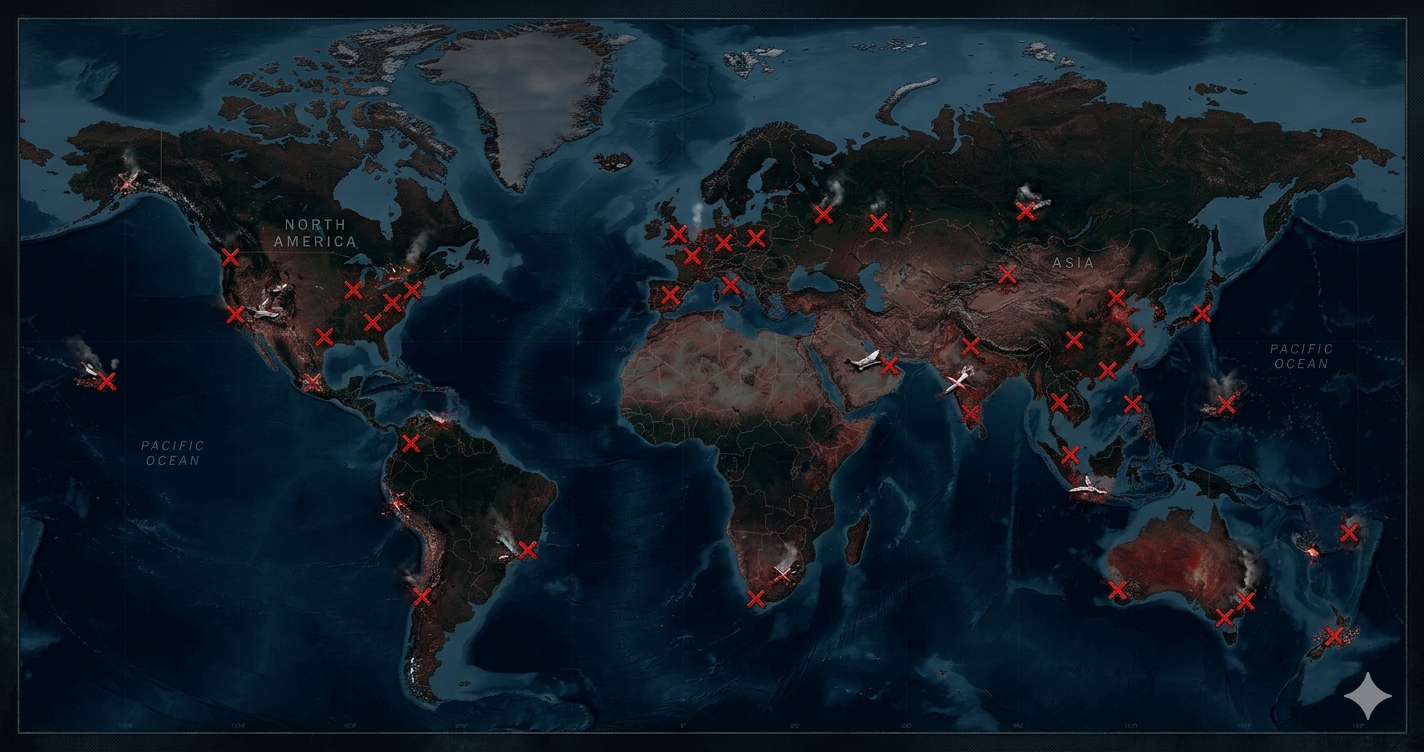
While Americans were watching yellow kiosks go dark at domestic airports, airlines were simultaneously collapsing in China, Mexico, Slovenia, Sweden, the Philippines, India, Malta, the United Kingdom, and the South Pacific. The same forces that brought down Spirit — soaring jet fuel prices, unsustainable debt, intense competition, and rising labor costs — were playing out in aviation markets across six continents.
This is the international story of the 2026 aviation crisis: the carriers that most people outside their home markets never heard of, and why their collapses matter just as much as the ones that made the front pages.
Joy Air (China) — When High-Speed Rail Wins
Joy Air might have been the most predictable collapse on the 2026 list. Not because the airline was unusually reckless or badly managed, but because it was fighting on two fronts simultaneously — and losing on both.
Founded in 2008 and based in Xi’an in northwestern China, Joy Air operated a small fleet of Boeing 737-800s and locally-produced Xi’an MA60 turboprop aircraft on domestic routes connecting its home city with destinations like Tianjin, Harbin, and Changsha. It was a regional carrier serving secondary routes in a market dominated by giants — Air China, China Southern Airlines, and China Eastern all operate far larger networks with stronger financial backing and government relationships that smaller carriers simply cannot match.
As passenger numbers declined over the years, Joy Air tried to pivot — shifting its strategy away from connecting smaller regional cities and toward routes into major Chinese hubs. It was a logical move on paper, but it meant entering into more direct competition with the dominant carriers on their strongest routes.
The airline was also squeezed from an entirely different direction: China’s high-speed rail network. For regional journeys — exactly the routes where Joy Air operated — high-speed rail has become a compelling alternative to flying. It is often cheaper, frequently faster when you factor in airport check-in and security, and far more convenient from city center to city center. For a regional airline trying to attract price-sensitive travelers, competing with high-speed rail is a fundamentally different challenge from competing with other airlines.
By the time Joy Air grounded all flights in late April 2026, it was battling a debt load exceeding 5 billion yuan — approximately $734.9 million. The airline also faced labor disputes involving unpaid wages owed to pilots and flight crew, which accelerated its collapse and created an operational crisis on top of the financial one.
Few details about the subsequent restructuring process were made publicly available. Thousands of passengers were left without clear information about refunds or alternative arrangements.
Why it matters globally: Joy Air’s story illustrates that the 2026 airline crisis is not purely a fuel story. In China, the existential challenge for regional carriers is structural — squeezed between dominant national carriers above and a world-class rail network below. More Chinese regional carriers face this same trap.
Magnicharters (Mexico) — The Two-Week Break That Never Ended
In late April 2026, Mexican low-cost carrier Magnicharters announced that it was suspending all flights for approximately two weeks due to what it described as operational problems. Two weeks, it said. Just a temporary pause.
That pause never ended.
In May 2026, Magnicharters formally filed for bankruptcy protection in the First District Court for Bankruptcy Proceedings in Mexico City. Mexican aviation regulators subsequently revoked the airline’s Air Operator Certificate, citing a lack of financial resources severe enough to constitute a safety risk — a particularly stark official judgment that left thousands of passengers stranded with no clear path to refunds.
Magnicharters had positioned itself as a low-cost option in Mexico’s domestic market, competing on price in a market where larger carriers like Aeromexico have significantly more financial resources and established route networks. The combination of rising fuel costs and the structural disadvantages of operating as a small budget carrier in a market with more powerful competitors proved fatal.
The decision by regulators to frame the airline’s financial situation as a safety risk is significant. It underscores a point that gets less attention than it deserves: financial distress in aviation is not just a passenger inconvenience. When airlines cannot afford to maintain aircraft, pay experienced staff, or purchase adequate fuel, the risks extend beyond canceled flights.
AlpAvia (Slovenia) — Europe’s Charter Sector Under Pressure
Slovenia’s charter carrier AlpAvia shut down in March 2026 after describing its financial problems as severe and unresolvable. Few specific details about the airline’s balance sheet or operations were made public before or after the collapse — the airline was small enough that it did not generate extensive coverage outside regional aviation media.
What AlpAvia’s collapse does represent is a signal about the broader health of Europe’s charter aviation sector. Charter operators — airlines that sell seat blocks to tour operators rather than selling tickets directly to individual passengers — have faced particular pressure in the post-pandemic environment. Tour operators themselves are under margin pressure and have pushed for lower charter rates, even as the costs of operating those charters have risen.
European charter carriers also face the added complexity of new sustainable aviation fuel mandates that are being phased in across the EU, adding cost burdens that smaller operators are poorly equipped to absorb.
H-Bird (Sweden) — The Slow Death of a Niche Carrier
Swedish charter airline H-Bird had a more drawn-out demise than most of the carriers on this list. Founded in 1991 to operate charter flights to remote parts of Sweden and to other European destinations, the airline targeted high-end travelers booking private charter services — a niche market that sounds profitable in theory but proved unsustainable in practice.
H-Bird lost its operating license in December 2025 over financing issues flagged by the Swedish Transport Agency. A Swedish court formally declared the airline bankrupt in early 2026. The airline had not run any commercial flights since the license revocation, so the bankruptcy declaration was the formal conclusion of a collapse that had already effectively happened.
The H-Bird story is a reminder that the 2026 aviation crisis is hitting charter and private aviation operators, not just mainstream commercial carriers. The economics of high-end charter flying are not immune to fuel cost spikes, and the customer base for these services — affluent leisure travelers — is highly price-sensitive when it comes to discretionary spending.
Royal Air Philippines — The First Casualty of 2026
Royal Air Philippines holds the distinction of being the first airline to formally cease operations in 2026. On January 4, the Manila-based carrier abruptly announced that it was suspending all commercial flights, leaving between 3,000 and 4,000 passengers with bookings through March 2026 with no flights and no immediate recourse.
The collapse did not arrive without warning for those paying close attention. International passenger numbers had fallen to just 51,800 in the first nine months of 2025, while domestic traffic plummeted by 63% to 38,800 — a devastating reversal from the 116,000 passengers the airline had carried in 2024. Chinese arrivals to the Philippines remained well below pre-pandemic levels, and competition from larger Philippine carriers continued to intensify.
The Philippines Securities and Exchange Commission formally placed the airline under receivership, with liabilities totaling approximately $234 million against assets of only $62 million. The net deficit of roughly $172 million made any recovery without significant external investment essentially impossible.
Air Calédonie (New Caledonia) — Grounded by Its Own Passengers
The Air Calédonie story is unlike any other on this list, because the airline was not primarily brought down by fuel costs or debt. It was effectively grounded by the very passengers it served.
New Caledonia’s domestic airline filed for insolvency proceedings in France on March 27, 2026, after a decision to move its main hub from Nouméa Magenta Airport to La Tontouta International Airport triggered weeks of activist blockades at island airports. Residents were protesting because the relocation — designed to save the airline money — would have dramatically increased domestic travel times and fares for communities that depend almost entirely on air transport.
The resulting blockades made it impossible for the airline to operate, earn revenue, or service its debts. The financial pressure that had been building since the pandemic was already severe — the airline had faced low passenger numbers since COVID-19 and further disruption from civil unrest in 2024. The blockades were the final straw.
Interestingly, after the bankruptcy filing became public, at least one activist group ended its blockade. Flights resumed, and the airline entered restructuring proceedings rather than full liquidation. But the case illustrates how uniquely fragile airlines are to operational disruption — and how quickly a social conflict can destroy a carrier that is already financially weak.
Malta’s Double Hit — Harmony Jets and Maleth-Aero
The small island nation of Malta experienced an unusual double wave of airline failures in early 2026, losing two charter carriers within weeks of each other.
Harmony Jets, a private charter carrier, had its Air Operator Certificate revoked after a regulatory audit uncovered serious safety violations. All company pilots were instructed to leave Harmony Jets aircraft wherever they were located — an immediate grounding with no transition period.
Less than a month later, Maleth-Aero — an ACMI and charter carrier that had been owned by U.S.-based AELF FlightService since 2021 — had its Maltese AOC revoked on April 10, 2026. The carrier had already lost its license to operate charter flights in Canada the previous year over a lack of liability insurance. With both Canadian and Maltese certifications gone, it had no viable path to continue operations.
The Maltese aviation sector’s regulatory record has attracted scrutiny, and the back-to-back collapses added to concerns about oversight standards for smaller charter operators within the EU.
The Common Thread Across Every Country
Look at this list from China to Mexico to Slovenia to Sweden to the Philippines to Malta, and one pattern emerges clearly. Every single airline on it was a smaller carrier — a regional operator, a charter provider, a budget carrier — trying to survive in a market dominated by larger, better-capitalized competitors.
The jet fuel crisis hit everyone, but it hit smaller carriers hardest because they lacked the scale to absorb cost shocks, the financial reserves to survive a sustained squeeze, and the revenue diversity to compensate through other income streams.
The same forces that destroyed Spirit Airlines in America destroyed Joy Air in China, Magnicharters in Mexico, and AlpAvia in Slovenia. The geography is different. The language is different. The specific circumstances are different. But the underlying story is the same.
See the complete list: Every Airline That Has Gone Bankrupt in 2026
Understand the root causes: Why Are So Many Low-Cost Airlines Collapsing in 2026?