Early Tuesday morning, June 2, 2026, residents of Kyiv were not sleeping. They were sheltering in metro stations, underground car parks, and basement corridors — packed shoulder to shoulder, waiting for the sounds of explosions to stop.
They had been warned. Ukrainian President Volodymyr Zelenskyy had been telling Ukrainians for days that intelligence reports pointed to a large-scale Russian assault coming. “Please heed air raid alerts and stay safe,” he had urged in his evening address on May 29. The following night, he repeated the warning. And yet, when the attack came, the scale of it still stunned even those who had been bracing for the worst.
Russia launched 656 drones and 73 missiles across Ukraine overnight, according to Ukraine’s air force — one of the largest single aerial assaults of the entire four-year war. The main targets were Kyiv, the central city of Dnipro, and the eastern cities of Poltava, Kharkiv, and Zaporizhzhia. When dawn came, at least 22 civilians were dead and 138 others wounded. Among the dead were two children. In Dnipro, rescue workers pulled the bodies of a 3-year-old child and an 8-year-old boy from the rubble of collapsed apartment buildings.
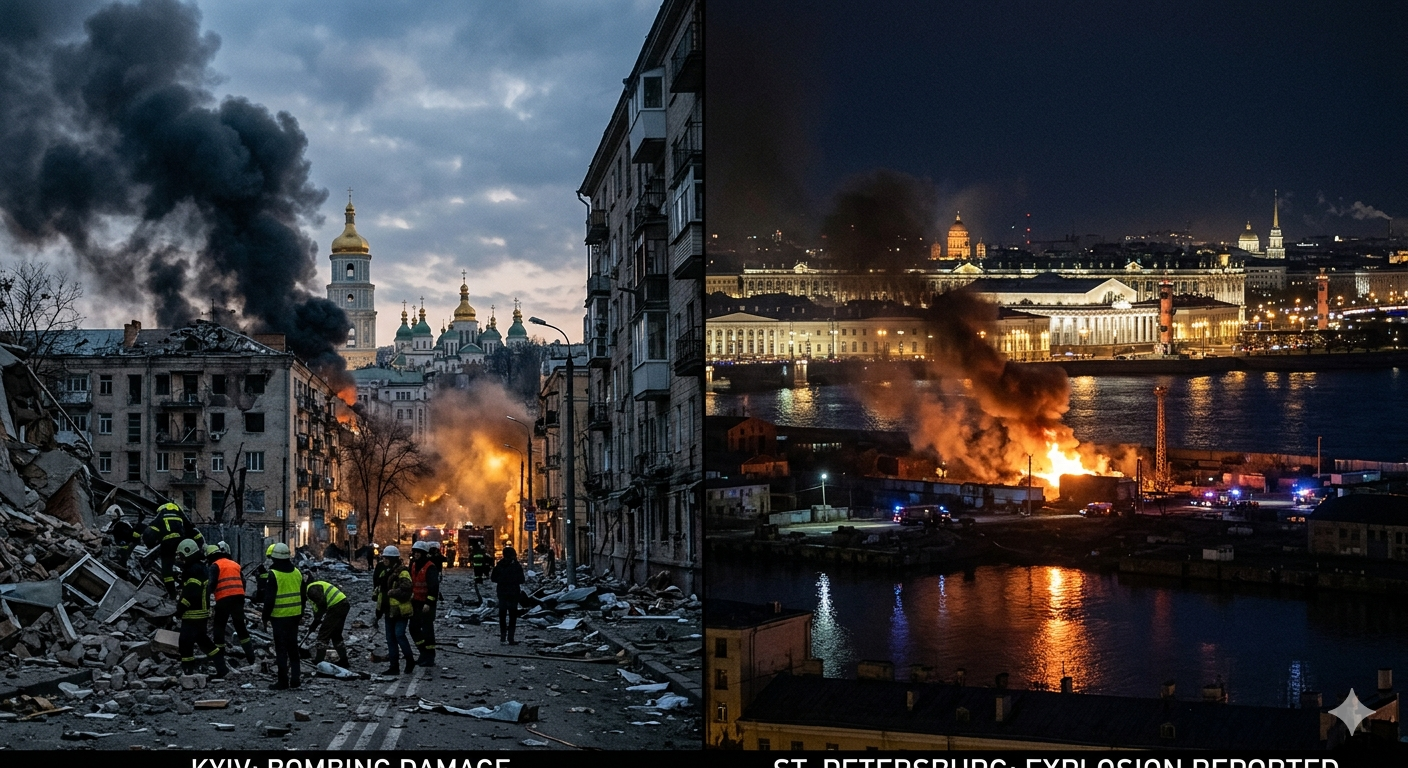
Ukraine struck back twenty-four hours later in a way that sent an unmistakable message. Long-range Ukrainian drones flew more than 1,000 kilometers — over 600 miles — to strike an oil export terminal in St. Petersburg, setting it ablaze and sending black smoke billowing over the skyline of the city where Vladimir Putin was born. The timing was deliberate: St. Petersburg was hosting Russia’s International Economic Forum, an annual event Putin uses to attract foreign investment and project an image of Russian economic stability. Zelenskyy made sure that image went up in smoke, literally.
This is where the Russia-Ukraine war stands today — more than four years since Russia’s full-scale invasion began in February 2022, and the killing is still accelerating.
The June 2 Attack: What Actually Happened
To understand the magnitude of Tuesday’s assault, some context is essential. Russia has been conducting aerial attacks on Ukraine throughout this war, but the June 2 attack stands out even by those grim standards.
Ukraine’s air force reported intercepting and suppressing 40 of the 73 missiles and 602 of the 656 drones. That means more than 83 drones and multiple ballistic missiles got through Ukrainian defenses and reached their targets — a direct consequence of depleted air defense resources.
In Kyiv, at least seven people were killed and 90 wounded, with 51 people hospitalized, including two children, according to Kyiv Mayor Vitalii Klitschko. At least 81 people were wounded in the capital alone, according to the head of Kyiv’s City Military Administration, Tymur Tkachenko. Residential apartment buildings were struck. In the Dniprovskyi district, three apartment buildings were damaged along with private residences. In the Podilskyi district, five residential buildings sustained damage.
In Dnipro, the casualties were even heavier. At least 16 people were killed in the Dnipropetrovsk region and 36 others were injured, including children. The mayor declared a day of mourning — and then, twenty minutes after making that announcement, another drone struck a residential building in his city.
In Poltava, Kharkiv, and Zaporizhzhia, the attacks continued throughout the day. The UN Humanitarian Coordinator in Ukraine, Matthias Schmale, noted that this was the third time these cities had been struck in as many weeks. “Instead of enjoying the start of the school summer break, children and their families spent the night in underground shelters, woken up by air raid sirens, explosions and uncertainty,” he said in a statement condemning the assault.
Russian President Vladimir Putin has escalated his aerial campaign in recent weeks in an apparent bid to take advantage of Ukraine’s shortage of US-made air defense systems and to persuade an increasingly pessimistic audience at home that Moscow is prevailing in the war.
That last point matters. It explains why the attacks are intensifying rather than tapering off, and why civilians — in apartment buildings, in hospitals, on residential streets — continue to bear the cost.
Ukraine’s Air Defense Crisis: Why More Missiles Are Getting Through
The June 2 attack exposed a critical vulnerability that Zelenskyy has been warning about for months: Ukraine is running dangerously short of the air defense interceptor missiles needed to stop Russia’s most lethal weapons.
Ukraine’s shortage of air defense systems stems in part from depleted US stocks — a consequence of the United States’ own military engagement elsewhere, including in the Iran conflict. Kyiv’s defenses remain capable of stopping most of Russia’s drones — 602 of 656 were shot down or neutralized on June 2. But ballistic missiles are a different category of threat entirely. Russia has recently deployed its powerful hypersonic Oreshnik ballistic missiles against Ukrainian targets, and these are the weapons that Ukrainian air defenses struggle most to intercept.
Zelenskyy described the June 2 attack as “an explicit statement by Russia: If Ukraine is not protected from ballistic missiles and other missile strikes, those strikes will continue.” He has made an urgent appeal for more US and European air defense support — specifically for the systems capable of intercepting hypersonic ballistic weapons.
The structural problem is stark: Ukraine’s partners have provided significant support, but the scale and pace of Russian aerial attacks has consistently outrun the pace of Western aid. Every interceptor missile fired by Ukrainian defenses needs to be replaced. Every replacement takes time to manufacture, transport, and integrate. And during that time, Russian missiles reach Ukrainian apartment buildings.
Ukraine Strikes Back: St. Petersburg Burns During Putin’s Forum
If Tuesday was Russia’s message to Ukraine, Wednesday was Ukraine’s reply — delivered directly to Vladimir Putin’s political showcase.
Ukrainian long-range drones struck an oil terminal in St. Petersburg and set it ablaze, Ukrainian President Volodymyr Zelenskyy confirmed Wednesday morning. The drones flew more than 1,000 kilometers — over 600 miles — to reach their target, demonstrating the extended range capabilities that Ukraine has developed for its drone program. Clouds of black smoke rose over the city’s port as the attack unfolded.
The timing was anything but coincidental. St. Petersburg was hosting Russia’s International Economic Forum — an annual event that Putin uses to attract foreign investors, project Russian economic confidence, and signal to the world that Russia is a stable, business-friendly partner despite being under sweeping Western sanctions. It is sometimes called “Putin’s Davos.” The airport briefly suspended flights because of the attack. Russian authorities cut off mobile internet services across parts of the city.
The Ukrainian strike did not stop there. Overnight drone attacks also hit the Kronstadt naval base — an historic base for Russia’s Baltic Fleet located near St. Petersburg — and a manufacturing plant involved in weapons production in Russia’s Tambov region, approximately 600 kilometers from Ukraine’s border.
Zelenskyy’s message was pointed. “Ukraine’s plan for long-range sanctions is being implemented exactly as needed to bring peace closer,” he wrote on social media. The framing was strategic: Ukraine’s strikes on Russian energy infrastructure — oil terminals, refineries, ports, pipelines — are designed to deprive Moscow of the oil export revenue it depends on to fund its military operations. Every barrel of oil that cannot be exported is a small reduction in Russia’s war chest.
Ukraine also conducted strikes on Russian-occupied territories, hitting two Pantsir air defense systems, a command post of the Russian 3rd Army Corps, and a tugboat in Crimea and Donetsk.
Russia’s response was swift. Moscow fired 198 long-range drones at Ukraine overnight Wednesday, according to Ukraine’s air force — which said 189 were neutralized. The cycle of attacks and counterattacks, escalating in both scope and destructive capacity, showed no signs of ending.
The Human Cost: Four Years of a War That Was Supposed to Last Days
It is worth pausing on the human dimension of what these military statistics represent.
The bodies of a 3-year-old and an 8-year-old were pulled from rubble in Dnipro. A 65-year-old woman named Olena Dniprovska and her 64-year-old husband Yevhen Dniprovskiy sat in the yard of their damaged Kyiv home, both injured by the strike. In Kherson, an 86-year-old woman was killed by overnight Russian shelling. Subways and shelters across Kyiv were packed to capacity from Monday night until 7am Tuesday, with residents of the capital living in the specific, grinding fear of a population that has been targeted from the air hundreds of times over four years.
This war began on February 24, 2022, when Russia launched what Putin described as a “special military operation” he apparently expected to conclude within days. Over four years later, Ukraine has not been conquered, Russian forces have not achieved their stated objectives, and the aerial bombardment of Ukrainian civilian areas has become one of the defining images of 21st-century warfare.
More than 4 million Ukrainians remain displaced within their own country. Millions more have left Ukraine entirely. The country’s energy infrastructure has been systematically targeted — power stations, water treatment facilities, heating systems — in what Ukrainian officials describe as a deliberate strategy to make life uninhabitable for Ukrainian civilians.
Western officials and analysts have consistently described Ukrainian drones as a significant countermeasure: pinning down Russian troops on the front line, choking Russian supply lines in occupied regions, and disrupting the oil facilities that provide vital revenue for Moscow’s military machine.
The Diplomatic Stalemate: Why Peace Remains Out of Reach
Against this backdrop of escalating violence, the question of a diplomatic end to the conflict remains as unresolved as ever.
Peace talks, brokered at various points with US involvement, have repeatedly stalled over fundamental disagreements that show no sign of being bridged. Ukraine’s core demand has been security guarantees — formal commitments from NATO members or other powers that would prevent Russia from simply regrouping and attacking again after any ceasefire. Russia’s core demand has been territorial — recognition of its occupation of Ukrainian regions including Crimea, Donetsk, Luhansk, Zaporizhzhia, and Kherson.
These positions remain irreconcilable. Zelenskyy has repeatedly said Ukraine will not cede sovereign territory as a condition of peace. Russia has shown no willingness to withdraw from occupied Ukrainian land. With peace talks deadlocked and battlefield progress stalled for both sides, the two countries have been exchanging intensifying aerial attacks — each side trying to impose costs on the other that might eventually force a change in position.
The June 2 attack on Kyiv and the June 3 counter-strike on St. Petersburg are the latest chapters in that grim dynamic. Russia kills Ukrainian civilians to erode Ukrainian morale and pressure the West. Ukraine strikes Russian energy infrastructure to reduce Moscow’s war revenue and pressure Russian public opinion. And ordinary people on both sides pay the price.
What the World Is Watching
For the international community, the June 2 attack prompted the standard cycle of condemnation and calls for restraint. The UN Humanitarian Coordinator condemned the assault. European leaders expressed horror at the civilian casualties. Zelenskyy called on Western allies to accelerate air defense deliveries.
What remains to be seen is whether the intensifying scale of the attacks — Russia’s largest aerial assault of the war just weeks before what had been hoped might be a period of diplomatic engagement — changes the calculus in Western capitals about the pace and scale of support for Ukraine’s air defenses.
The United States has been the largest single supplier of military aid to Ukraine since the war began, but that support has faced domestic political headwinds and competing military demands. Ukraine’s shortage of interceptor missiles is not a technical problem — the missiles exist, and the systems work. It is a political and industrial problem: the question of how many weapons Western governments are willing to manufacture and transfer, and how quickly.
Every day that question remains unanswered, Ukrainian air raid sirens sound. And Ukrainian families spend another night in underground shelters, waiting for the explosions to stop.
Key Takeaways
- On June 2, 2026, Russia launched one of the largest aerial assaults of the war — 656 drones and 73 missiles — targeting Kyiv, Dnipro, Kharkiv, Poltava, and Zaporizhzhia.
- At least 22 civilians were killed and 138 wounded, including two children. Rescue workers pulled a 3-year-old child from apartment rubble in Dnipro.
- Ukraine’s air defenses intercepted 602 drones and 40 missiles — but Ukraine’s shortage of US-made air defense systems allowed multiple missiles to reach residential areas.
- On June 3, Ukraine struck back — long-range drones flew 1,000+ km to hit a St. Petersburg oil terminal during Putin’s International Economic Forum, sending black smoke over the city.
- Ukrainian drones also struck the Kronstadt naval base and a weapons production facility in Russia’s Tambov region.
- The UN, European leaders, and Zelenskyy have called for urgent delivery of additional air defense systems capable of intercepting hypersonic ballistic missiles.
- Peace talks remain deadlocked with no diplomatic breakthrough in sight. The aerial war is intensifying on both sides.