The Budget Flight You Booked Might Not Exist Tomorrow
Not long ago, cheap flights felt almost too good to be true. You could hop on a budget carrier, pay less than the price of a nice dinner, and still get from A to B without thinking twice. That era is quietly ending.
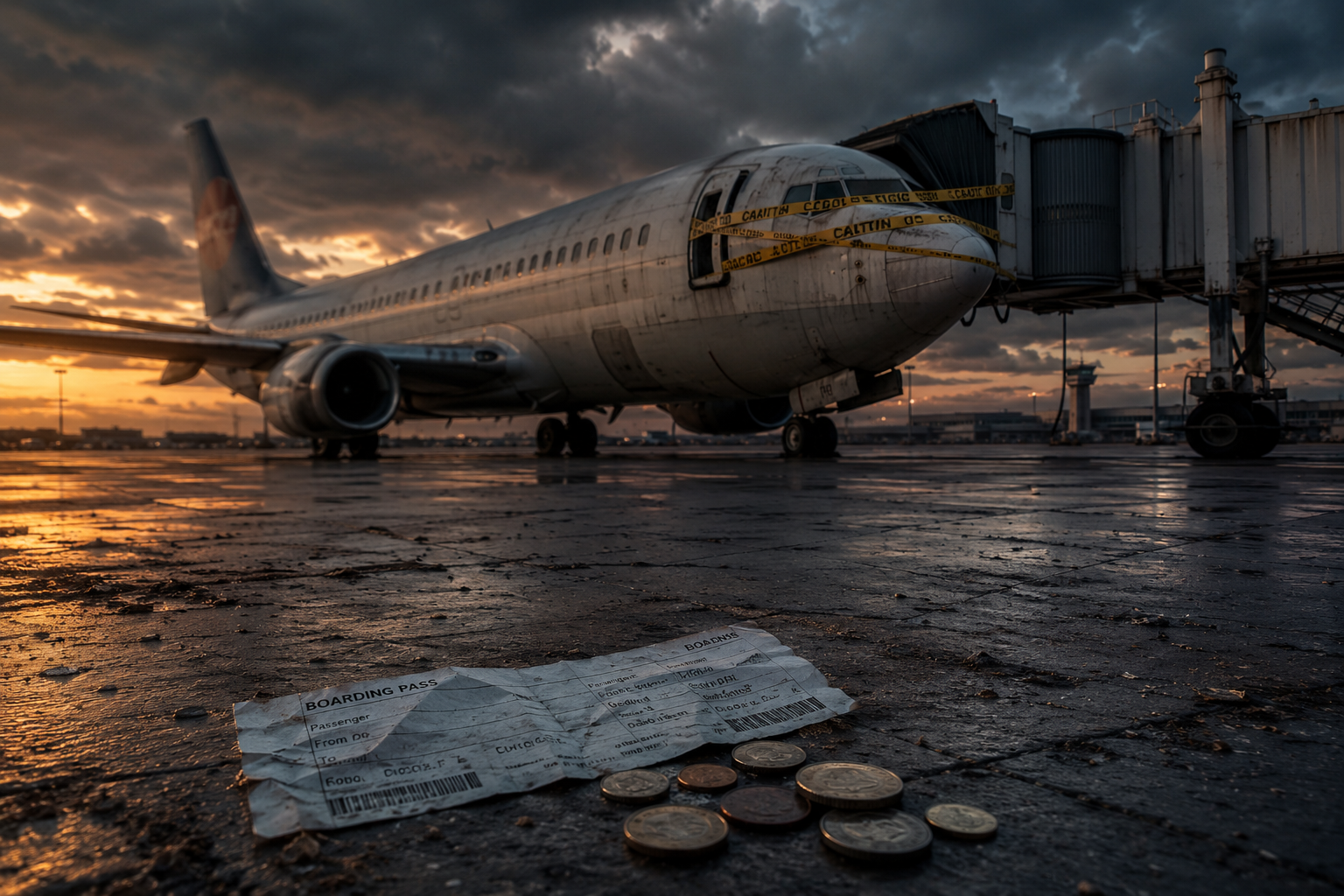
In 2026, the aviation world has been rocked by a wave of collapses unlike anything seen since the post-9/11 chaos or the 2008 financial crisis. Spirit Airlines — once the poster child of ultra-cheap flying in America — canceled every single flight on May 2 and shut down for good. Mexico’s Magnicharters stranded thousands of passengers overnight. China’s Joy Air grounded its fleet and filed for restructuring. Sweden’s H-Bird was declared bankrupt. Slovenia’s AlpAvia ceased operations. Houston-based Starflite Aviation had its license revoked by the FAA.
The list keeps growing….
So what is actually happening? Is this just bad luck hitting a few unlucky carriers, or is something deeper going wrong across the entire low-cost airline model? The answer, as it turns out, is both more complicated and more alarming than most people realize.
1. Jet Fuel Prices Hit a Breaking Point
If you want to understand why budget airlines are collapsing, start with jet fuel. It is, quite literally, what keeps planes in the air — and right now, it is costing airlines more than at almost any point in modern aviation history.
Driven largely by geopolitical instability in the Middle East, jet fuel prices surged to around $230 per barrel in 2026. That number might not mean much on its own, but consider this: fuel accounts for up to 30% of an airline’s total operating costs in normal times. When that cost nearly doubles, the entire financial model of a budget carrier falls apart almost instantly.
Legacy airlines like Lufthansa, Delta, and United are hurting too — American Airlines has warned that rising fuel costs could reduce its earnings by over $4 billion. But large carriers have tools that smaller budget airlines simply do not have. They fly premium routes with higher margins, they have more diverse revenue streams, and — crucially — many of them hedge their fuel costs by locking in prices in advance.
Low-cost carriers, on the other hand, typically operate on razor-thin margins. Their entire pitch to customers is a low ticket price, which means they cannot easily absorb cost shocks the way bigger airlines can. When jet fuel spikes, they have nowhere to hide.
Spirit Airlines is the clearest example of this dynamic. Analysis of its financial position shows that by mid-April 2026, jet fuel prices had surged to approximately $4.24 per gallon locally — an 89% increase over the airline’s own baseline financial modeling. That single gap created an immediate cost burden of around $360 million for the remainder of the year. The problem? Spirit’s entire cash reserves at the end of 2025 were only between $273 million and $337 million. The math was simply impossible.
Many carriers compounded this problem by reducing or eliminating their fuel hedging programs during the years of relatively stable prices in 2024 and 2025 — a decision that looked reasonable at the time but left them completely exposed when prices exploded.
2. Debt Had Already Piled Up to Dangerous Levels
The fuel crisis did not appear in a vacuum. For many of these airlines, it was the final blow landing on a body that was already badly bruised.
Spirit Airlines had accumulated over $3.3 billion in long-term debt by mid-2024. It had reported net losses of $554 million in 2022 and $447 million in 2023. By the time it filed its second Chapter 11 bankruptcy in August 2025 — less than six months after emerging from its first — it was carrying $2.4 billion in long-term debt and negative free cash flow of $1 billion. A proposed merger with JetBlue that might have saved the airline was blocked on antitrust grounds in January 2024, removing the last viable exit ramp.
Joy Air in China tells a similar story. The regional carrier had been battling a debt load exceeding 5 billion yuan — roughly $734.9 million — when it finally ceased operations. That level of debt, combined with declining passenger numbers and rising costs, left the airline with no buffer when conditions deteriorated.
For budget carriers operating on thin margins, debt is not just a financial inconvenience. It is an existential vulnerability. When revenues dip even slightly, or costs spike even briefly, there is nothing left to absorb the shock.
3. Labor Disputes Added Fuel to the Fire
Running an airline is labor-intensive in ways that most industries are not. Pilots, cabin crew, mechanics, and ground staff all require specialized training, and their compensation has been rising sharply in recent years as a post-pandemic shortage of qualified aviation workers continues to bite.
For Joy Air, labor problems were not just a cost issue — they became a reputational and operational crisis. The airline faced a series of disputes involving unpaid wages owed to pilots and flight crew, which compounded its already fragile financial position. When workers are not getting paid, they leave. And when pilots leave, planes cannot fly.
Across the industry more broadly, wage agreements are rising fast. JetBlue, for instance, reached labor deals in 2026 that boosted crew costs by 26% through 2029 — bringing pilot pay in line with the big legacy carriers and erasing one of the key cost advantages that budget airlines historically relied upon.
This is a structural shift, not a temporary blip. The days of budget carriers paying pilots significantly less than major airlines are largely over. That changes the economics of the low-cost model in ways that cannot easily be fixed.
4. Competition Squeezed Margins from Every Direction
Budget airlines did not just face pressure from their costs. They also faced intensifying pressure on the revenue side, as competition from multiple directions made it harder and harder to fill seats at profitable prices.
In the United States, Spirit was caught in a brutal squeeze. On one side, legacy carriers like Delta and United have spent years improving their basic economy offerings — essentially building a low-cost tier within their own networks. On the other side, ultra-low-cost rivals like Frontier and Allegiant were fighting for the same budget-conscious passengers. Meanwhile, Southwest Airlines — long the gold standard of low-cost flying — continued commanding strong customer loyalty.
The situation in China was even more extreme. Joy Air operated in a domestic market dominated by Air China and China Southern Airlines, both of which have the scale, financial backing, and government relationships that regional carriers simply cannot match. On top of that, China’s extensive high-speed rail network provides travelers with a reliable and often cheaper alternative for shorter journeys — squeezing budget carriers from two directions at once.
When you have to compete with both bigger airlines and an entirely different mode of transport, maintaining a viable route network becomes extremely difficult.
5. Regulatory Failures and Safety Issues Accelerated Some Collapses
Not every airline failure in 2026 was purely about economics. In some cases, regulatory intervention was the direct trigger — often because corners had been cut in ways that compromised safety.
Starflite Aviation, a Houston-based charter carrier, had its Air Operator Certificate revoked in March 2026 after the FAA alleged that the company’s owners had falsified pilot training records in an attempt to bypass federal safety audits. Harmony Jets in Malta also lost its operating certificate over safety concerns discovered during an audit.
These cases are a reminder that financial pressure does not just threaten passengers through flight cancellations. When airlines are struggling financially, the temptation to cut corners on safety, maintenance, and regulatory compliance can become very real — and the consequences can be severe.
6. The Business Model Itself May Be Broken
Zoom out from the individual stories, and a bigger question starts to come into focus: Is the ultra-low-cost airline model fundamentally broken?
The entire pitch of a budget carrier rests on one idea — strip out every possible cost and fill every possible seat, so you can charge the lowest fares and still turn a profit. It works beautifully when fuel is cheap, labor is compliant, competition is limited, and demand is strong.
But when any one of those conditions changes, the model becomes fragile. When multiple conditions change at the same time — as they have in 2026 — it can become impossible.
Legacy airlines have fat built into their systems: premium cabins, loyalty programs, cargo revenue, extensive route networks. When things get hard, they can cut routes, raise prices in premium cabins, or lean on their loyalty programs to generate cash. Budget carriers have none of those levers to pull. The only way they make money is by selling cheap seats, and the only way they sell cheap seats is by keeping costs low. When costs rise beyond a certain point, the entire model ceases to function.
Aviation analysts are already warning that carriers like JetBlue — which carries $5.3 billion in long-term debt and lacks the operational scale of legacy carriers — face significant risks if economic conditions do not improve. A group of ultra-low-cost carriers including Frontier and Allegiant reportedly sought $2.5 billion in government assistance just to offset the impact of higher fuel prices. That is not a sign of a healthy business model. That is a sign of an industry in distress.
What This Means for Travelers
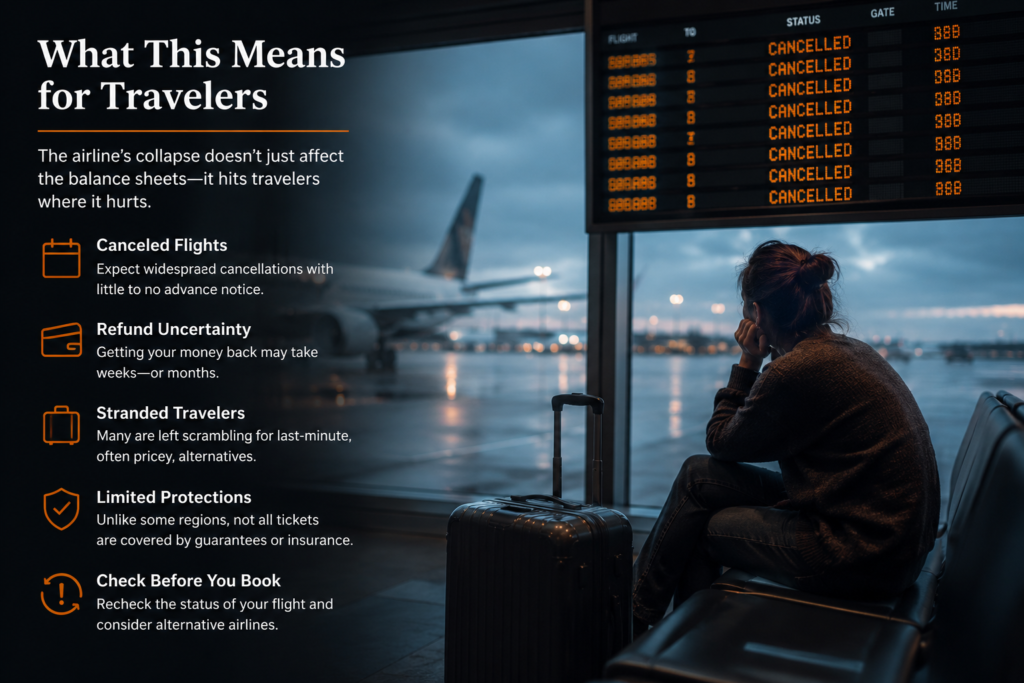
If you fly regularly — especially on budget carriers — the wave of collapses in 2026 has real, practical implications for you.
Fares are going up. Airfare is already up nearly 15% year over year, and the trend is not reversing anytime soon. Fewer budget carriers means less competition, which means higher prices for everyone.
Your loyalty points are not guaranteed. When Spirit shut down, Free Spirit frequent flyer points became worthless overnight. If you have accumulated points with a budget carrier that is showing financial stress — frequent route cancellations, news reports about debt — consider using them sooner rather than later.
Fewer cheap routes will exist. When budget carriers disappear, the routes they served either disappear entirely or become the exclusive domain of more expensive legacy carriers. For passengers in smaller cities that were served primarily by low-cost carriers, that can mean losing air access altogether.
Travel insurance matters more than ever. If you book with a carrier that subsequently goes bankrupt, your options without travel insurance are limited. Credit card chargebacks can help if you paid by card, but the process takes time and is not guaranteed.
Is There Any Light at the End of the Tunnel?
The honest answer is: it depends on things nobody can fully control right now.
If geopolitical tensions ease and fuel prices stabilize, some budget carriers could find their footing again. Airlines that survived this period — those with better hedging strategies, lower debt, and stronger competitive positions — may emerge with less competition and healthier margins.
Sustainable aviation fuel (SAF) is often cited as a long-term solution to the fuel cost problem, but it currently comes at a premium that most budget carriers cannot absorb. The technology exists, but the economics are not yet there for mass adoption.
What seems clear is that the aviation industry is undergoing a structural shift. The era of $29 cross-country fares and $49 transatlantic deals may be genuinely over for the foreseeable future. The surviving airlines will be those that can balance competitive pricing with genuine financial resilience — and that balance is harder to strike than it used to be.
Conclusion: A Reckoning That Was a Long Time Coming
The collapse of Spirit Airlines made headlines. The shutdown of Joy Air, Magnicharters, AlpAvia, Starflite, and H-Bird each told the same story in different languages and different time zones.
This is not a string of coincidences. It is a reckoning — for airlines that borrowed too much, hedged too little, paid their workers too late, and built business models that could only survive in perfect conditions. The conditions in 2026 are anything but perfect.
For passengers, the message is clear: the golden age of dirt-cheap flying is under serious pressure. For the industry, the message is equally stark: the low-cost model as it existed for the past decade needs to evolve — or more carriers will follow Spirit into the history books.