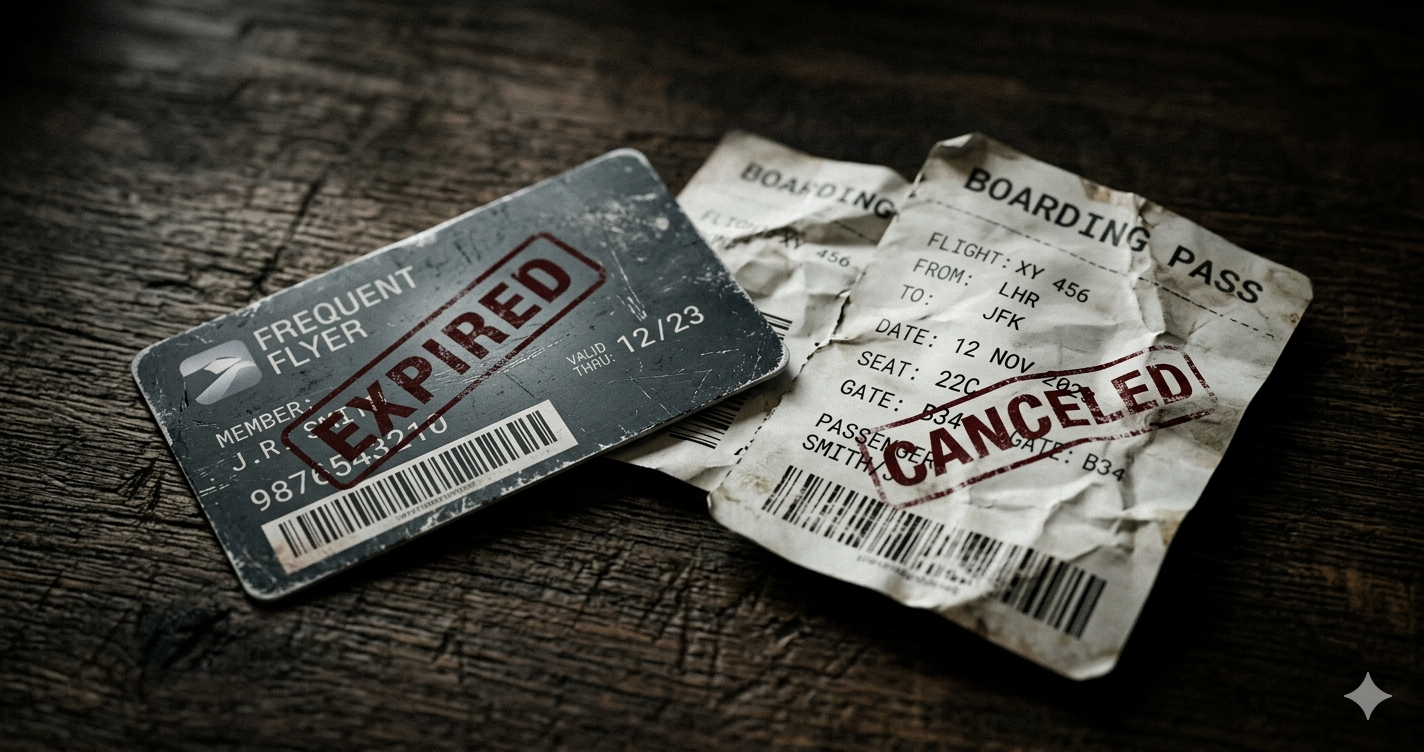
One Night, Millions of Miles — Gone
On the night of May 1, 2026, millions of Free Spirit frequent flyer miles were worth something. By 3:00 AM on May 2, they were worth exactly nothing.
When Spirit Airlines shut down, it did not just cancel flights. It wiped out an entire loyalty currency overnight. Members who had spent years accumulating points — flying countless miles, booking credit cards, referring friends — woke up to find their balances frozen and their points effectively worthless. No redemption options. No transfer to another airline. No cash value.
Just gone.
This is the risk that most frequent flyers never think about — and with more airline bankruptcies hitting the aviation industry in 2026 than in any recent year, it is a risk that every traveler with a loyalty account needs to understand right now.
What Actually Happens to Miles When an Airline Goes Bankrupt?
When an airline files for Chapter 11 bankruptcy — the restructuring kind — the loyalty program often continues operating. This is intentional. Loyalty programs generate revenue (airlines sell miles to credit card companies and partners), and keeping the program alive helps maintain passenger confidence during restructuring. When American Airlines, Delta, and United filed for Chapter 11 in their respective crises, their frequent flyer programs kept running throughout.
The situation is completely different when an airline enters Chapter 7 or full liquidation — as Spirit did.
In a liquidation, the airline is winding down entirely. The loyalty program is a liability — the airline owes miles to members. In a bankruptcy estate, liabilities are paid out in a strict legal order: secured creditors first, then unsecured creditors, then — if anything is left — everyone else.
Frequent flyer program members are typically treated as unsecured creditors. In most airline liquidations, unsecured creditors receive pennies on the dollar at best, and often nothing at all.
Your miles are not in a separate protected account. They are not backed by any government guarantee. They exist as a promise from the airline — and when the airline ceases to exist, that promise has nothing behind it.
What Happened Specifically to Free Spirit Points?
When Spirit Airlines collapsed, Free Spirit points were immediately frozen. The bankruptcy court took control of the estate, and loyalty point balances became part of the unsecured creditor pool.
There were two theoretical paths forward:
Path A — Points simply disappear (most likely): The bankruptcy estate is liquidated, assets are sold, and after secured creditors are paid, there is little or nothing left for unsecured creditors. Free Spirit points become permanently worthless. This is the most probable outcome for most members.
Path B — Another airline acquires the database (possible but not guaranteed): If a competing carrier purchases Spirit’s customer data as part of the bankruptcy asset sale, they might offer to convert Free Spirit points to their own currency — typically at an unfavorable rate. This has happened in some past airline bankruptcies but did not appear to materialize for Spirit at the time of publication.
The bottom line: the vast majority of Free Spirit members will not recover any meaningful value from their points.
Which Airline Miles Are Most at Risk Right Now?
With the aviation industry under severe financial pressure in 2026, it is worth taking a hard look at which loyalty programs carry elevated risk.
JetBlue TrueBlue is the program that has attracted the most concern. JetBlue’s founder David Neeleman publicly stated that the airline could face bankruptcy if fuel prices reach $4.50 per gallon — a level that has already been approached in 2026. Analysts at J.P. Morgan projected that at those prices, JetBlue could post a loss of $1.3 billion in 2026, which could push its total debt to around $9 billion. Leading aviation analysts have placed JetBlue’s bankruptcy risk by 2027 at greater than 75%. JetBlue TrueBlue points should be treated with caution.
Frontier Miles also carry elevated risk. The ultra-low-cost carrier sought government assistance alongside other budget airlines in 2026 to offset fuel costs — a sign of serious financial strain. Frontier’s bankruptcy risk is estimated at around 45 to 50% by some analysts.
Allegiant Allways is in a relatively stronger position according to available analysis — Allegiant has been more consistently profitable and has more manageable debt levels than its ultra-low-cost peers.
Legacy carrier programs — Delta SkyMiles, United MileagePlus, American AAdvantage — are in significantly stronger positions. These airlines have diversified revenue streams, large cargo operations, and enough financial cushion to weather the current crisis. Their programs are not risk-free, but they are far less exposed than budget carrier programs.
7 Things You Should Do With Your Miles Right Now
1. Audit All Your Loyalty Accounts Today
Log into every loyalty program you are a member of and note your current balance. If you have not checked in months, some balances may have already expired. Make a list of which programs you hold points with and which airlines those programs belong to.
2. Prioritize Using Points With Financially Stressed Carriers
If you hold a meaningful balance with JetBlue, Frontier, or any other airline showing signs of financial stress, use those points as soon as possible. A redemption you make today has value. A balance that exists when the airline collapses has none.
3. Look for Transfer Options
Some loyalty programs allow you to transfer points to hotel programs, other airline programs, or partner programs. JetBlue TrueBlue, for example, has transfer partners. If you can move your balance out of a risky airline program into a more stable one, consider doing it — even at a slightly unfavorable transfer rate. Something is better than nothing.
4. Use Miles for High-Value Redemptions, Not Gift Cards
If you are going to use miles quickly, use them for flight redemptions rather than merchandise or gift cards — you typically get the highest per-mile value on flight redemptions. Even if the award flight is not perfect, the cash equivalent saved is real money.
5. Stop Accumulating Miles With At-Risk Carriers
If you hold a co-branded credit card that earns points with a financially stressed airline, consider whether it makes sense to keep accumulating. Every point you earn with that card is a point that could disappear if the airline collapses. If the card has other benefits worth keeping, that is a separate question — but stop thinking of the miles as a reliable savings account.
6. Keep Your Miles Active to Prevent Expiration
Many loyalty programs expire miles after a period of inactivity — typically 12 to 18 months with no account activity. A small earning or redemption transaction resets the clock. Even if you are not flying, make sure your accounts stay active.
7. Consider Credit Card Points as a Safer Store of Value
Points earned through general-purpose travel credit cards — like Chase Ultimate Rewards, American Express Membership Rewards, or Capital One Miles — are stored with the credit card issuer, not the airline. Even if every airline on the transfer partner list collapsed, your credit card points would still exist and could be redeemed for cash back or statement credits. This makes them a safer store of travel value than airline-specific miles in uncertain times.
The Bigger Picture: Why This Matters Now More Than Ever
The loyalty program question is not abstract in 2026. The industry has already seen multiple carriers collapse this year, wiping out loyalty balances without warning. The conditions that caused those collapses — high fuel prices, unsustainable debt, intense competition — have not gone away.
Aviation analysts are warning that more bankruptcies could follow before the year is out. If you are holding significant balances in budget airline loyalty programs, you are taking on more risk than you might realize.
The safest approach is simple: treat airline miles as a use-it-or-lose-it currency, not a savings account. Use them when you have something good to redeem them for. Do not let large balances sit idle with airlines under financial stress.
See which airlines have already collapsed: Every Airline That Has Gone Bankrupt in 2026
If your airline does collapse: What to Do If Your Airline Goes Bankrupt
Full story of Spirit’s collapse: Spirit Airlines Is Gone Forever