There are moments in business history that mark a clear dividing line between what came before and what comes after. The moment Apple launched the iPhone. The moment Amazon turned a bookstore into a cloud computing empire. The moment Facebook bought Instagram for $1 billion and everyone thought Mark Zuckerberg had lost his mind.
This week, Google’s parent company Alphabet wrote its own entry into that list.
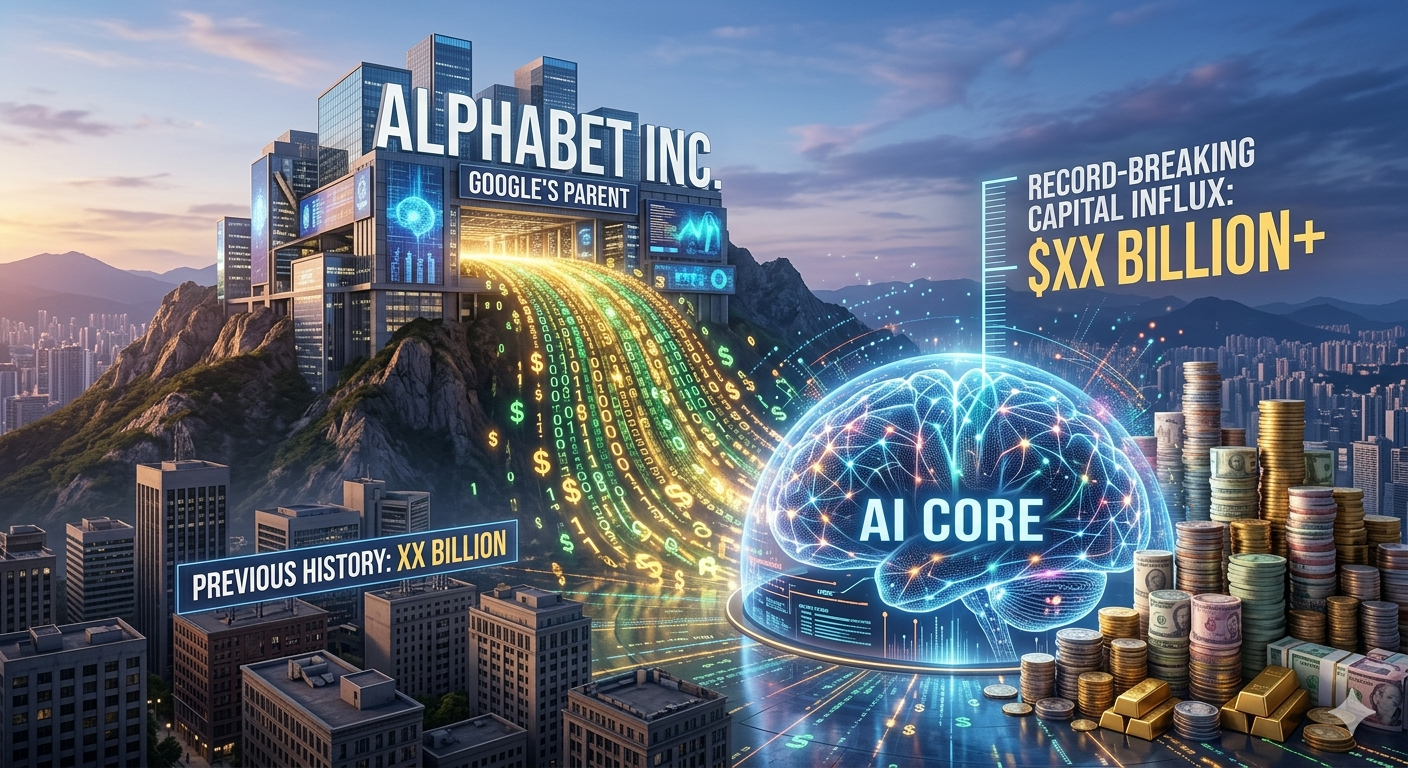
On June 1, 2026, Alphabet announced plans to raise $80 billion through a package of stock offerings to fund its artificial intelligence infrastructure. Two days later, after investor demand overwhelmed the original terms, the company upsized the raise to $84.75 billion — the largest equity capital raise in the history of publicly traded technology companies. Possibly the largest of any company, ever.
And then there’s the headline that made every financial analyst in the world sit up straight: Warren Buffett’s Berkshire Hathaway committed $10 billion of that raise in a private placement.
When the most famously conservative, patient, long-term investor in American history writes a $10 billion check to back an AI infrastructure buildout, something important is being signaled about where the world is heading. Let’s unpack exactly what happened, why it matters, and what it means for the future of technology, business, and the internet as we know it.
What Alphabet Actually Announced — The Numbers Explained
The deal is structured in three parts, and understanding the structure matters because not every dollar is going to the same place.
Part 1: $30 billion in underwritten public offerings — upsized to $34.75 billion after investor demand exceeded expectations. This includes roughly $18 billion in Class A Common Stock and Class C Capital Stock, priced at $355.20 and $351.80 per share respectively, and $16.75 billion in depositary shares representing mandatory convertible preferred stock.
Part 2: $10 billion private placement with Berkshire Hathaway — split equally between Class A Common Stock at $351.81 per share and Class C Capital Stock at $348.20 per share. This investment adds to a position Berkshire has been quietly building in Alphabet since the third quarter of 2025.
Part 3: $40 billion at-the-market (ATM) offering program — under which Alphabet can sell Class A and Class C shares directly into the open market over time, expected to begin in Q3 2026. This portion is primarily aimed at covering approximately $30 billion in tax obligations linked to employee equity award vesting. It’s important to note: this chunk isn’t going directly into AI data centers — it’s covering Alphabet’s own internal administrative financial obligations.
The underwritten stock tranche was expected to close June 4, 2026, and the depositary share offerings on June 5. This is happening right now.
The net proceeds from the stock offerings will be approximately $17.8 billion, while depositary share offerings generate approximately $16.6 billion, after deducting underwriting discounts and expenses. That combined roughly $34 billion — alongside the $10 billion Berkshire check — is the real AI war chest.
The Context: Why Google Needed to Do This
To understand why Alphabet just made the largest equity raise in tech history, you need to understand the pressure the company is operating under.
Google’s own head of AI infrastructure, Amin Vahdat, told employees internally that the company must double its serving capacity roughly every six months just to keep up with customer demand. Read that again: doubling capacity every six months. That’s an almost vertical growth curve for physical infrastructure — data centers, servers, networking equipment, power supply, and cooling systems.
The company confirmed this in its Q1 2026 earnings, which were, by any measure, extraordinary. Alphabet revenues grew 22% year-over-year to $109.9 billion — its 11th consecutive quarter of double-digit growth. Google Search revenues rose 19%. YouTube advertising grew 11%. But the real story was Google Cloud, which surged 63% to $20 billion in a single quarter.
Even more striking: Google Cloud’s contract backlog nearly doubled quarter-on-quarter to over $460 billion. That backlog represents future revenue already committed by enterprise customers — companies that have signed contracts to use Google Cloud’s AI infrastructure and are waiting in line for capacity to come online.
As Alphabet put it plainly in its statement: “The company is experiencing strong demand for its AI solutions and services from enterprises and consumers, at levels that are exceeding the company’s available supply.”
This is not a company raising money because it’s struggling. This is a company raising money because it’s growing so fast it literally cannot build fast enough to serve its own customers.
The Record Books: Largest Equity Raise in History
To fully appreciate the scale of what just happened, consider this: according to Bloomberg’s data, Alphabet’s equity offering is set to be the largest of all time.
For context, the previous record was held by Brazilian oil producer Petrobras, which raised $70 billion in a common and preferred stock sale in 2010. That record stood for 16 years. Alphabet didn’t just beat it — it surpassed it by nearly $15 billion in a matter of hours.
This is also Alphabet’s first new share issuance since 2005 — a full 21 years. For two decades, the company returned capital to shareholders through buybacks rather than raising new equity. The decision to reverse that approach and issue new stock is a meaningful signal: Alphabet believes the return on AI infrastructure investment is so compelling that it’s worth diluting existing shareholders to fund it.
Markets, for their part, appeared to agree. Alphabet’s market capitalization was tracking toward a record $4.3 trillion valuation in the days following the announcement.
Warren Buffett’s $10 Billion Signal
In any other context, a $10 billion investment would be the lead story. Here, it’s almost an afterthought given the scale of the broader raise — but it deserves its own analysis.
Berkshire Hathaway has spent most of the last decade being skeptical of technology companies. Buffett himself famously declined to invest in Amazon early, later calling it one of his biggest investment mistakes. He built a massive position in Apple largely because he viewed it as a consumer products company with exceptional brand loyalty rather than a technology business in the traditional sense.
The $10 billion commitment to Alphabet — described as adding to a position Berkshire had already been building since Q3 2025 — represents something different. It’s a bet on AI infrastructure as durable, defensible, essential infrastructure. The kind of moat investment that Buffett’s framework has always favored: a business so deeply embedded in how the world operates that its competitive position becomes almost unassailable over time.
It signals that management’s bet on AI infrastructure is drawing institutional conviction at the highest level. When the world’s most respected long-term investor backs your capital raise as an anchor investor, the message to every other institutional player in the market is unmistakable: this is a generational bet, and the smart money is in.
The AI Arms Race: Google vs. Everyone Else
Alphabet’s raise doesn’t exist in isolation. It’s part of something much larger — a technology spending race that makes previous corporate investment cycles look modest by comparison.
Google, Amazon, Microsoft, and Meta alone collectively plan to allocate $725 billion to capital expenditures in 2026 — up a staggering 77% from last year’s already record-breaking $410 billion.
Let that number settle: $725 billion in a single year from four companies.
Amazon is projecting $200 billion in capital expenditures. Alphabet is targeting $175 billion to $185 billion. Meta is guiding $115 billion to $135 billion. Microsoft is tracking toward $190 billion. And beyond this year, Alphabet has already stated it expects its 2027 capital expenditures to “significantly increase” compared to 2026.
The five main hyperscalers — add Oracle to the list — have plans to add roughly $2 trillion in AI-related assets to their balance sheets by 2030. As Cisco CEO Chuck Robbins put it on Yahoo Finance: “Infrastructure spending is cool again.”
It’s worth understanding what all this money is actually buying. These aren’t software investments or marketing budgets. This is physical infrastructure: data centers spanning hundreds of acres, custom AI chips consuming gigawatts of electricity, undersea cables connecting continents, and the cooling systems needed to stop billions of processors from melting. The AI future being built right now is as much a civil engineering project as it is a software one.
The challenge is real and urgent. Every hyperscaler reports that its markets are supply-constrained. They have more customers willing to pay for AI compute than they have compute to sell. The $725 billion collective spend is the industry’s attempt to close that gap.
What Google Is Actually Building
So where does the money go? Alphabet’s AI infrastructure investment is not one thing — it’s a full-stack buildout across multiple layers of the technology ecosystem.
Custom Silicon. Google has been developing its own AI chips — Tensor Processing Units (TPUs) — for years. These custom processors, designed specifically for AI workloads, give Google a cost and performance advantage over competitors who rely on third-party chips. Google’s head of AI infrastructure credited the company’s strategy of building custom AI chips, foundation models, and products in-house for giving it a cost and research advantage over competitors.
Data Centers. Alphabet agreed in December 2025 to acquire data center operator Intersect for $4.75 billion, adding to its global footprint of facilities designed to handle AI workloads. With the new capital, expect significantly more data center construction and acquisition globally.
Google Cloud. With a $460 billion backlog and 63% year-over-year revenue growth, Google Cloud is the commercial engine that justifies the infrastructure investment. Enterprise customers — banks, healthcare systems, retailers, manufacturers — are committing to Google’s AI platform at a pace that has overwhelmed available supply. The new capital gives Alphabet the ability to serve that demand instead of turning customers away.
Gemini and AI Products. Google’s Gemini AI assistant and the broader suite of AI-enhanced products — Google Search, Google Workspace, YouTube, Google Maps — all run on the same infrastructure being built with this capital. Every improvement in AI compute translates directly into better, faster, more capable products for the billions of people who use Google every day.
What This Means for You
It’s easy to look at numbers like $84.75 billion and feel like this is a story about rich companies getting richer. But the implications of this investment extend to everyone who uses the internet.
For everyday consumers: More AI infrastructure means faster, more capable AI tools — in your search results, in your email, in your smartphone, and in the services you use every day. The Google you use in 2028 will be significantly more powerful than the one you use today, and Alphabet’s infrastructure investments are a direct reason why.
For businesses of all sizes: Google Cloud’s capacity expansion means more businesses can access enterprise-grade AI without building their own infrastructure. Small businesses and startups benefit from the competitive pressure between hyperscalers — which drives down prices and improves access to AI tools that previously only Fortune 500 companies could afford.
For investors and workers in tech: The $725 billion being spent on AI infrastructure in 2026 alone is creating an enormous economic wave — in chip manufacturing, construction, power generation, networking, and software development. The Financial Times noted that Big Tech’s record AI spending has already begun to eat into free cash flow. With Big Tech investing a record $725 billion in AI projects, the combined free cash flow of Amazon, Google, Microsoft and Meta is projected to fall to $4 billion during Q3 — a sharp decline that reflects the sheer scale of capital being deployed.
For national and geopolitical competition: The United States’ AI infrastructure leadership is being built right now, in real time, with investments of this magnitude. Countries that fall behind in AI compute capacity face strategic disadvantage in every domain where AI becomes critical — from healthcare to defense to financial systems to education.
The Questions Nobody Can Fully Answer Yet
The Alphabet raise also raises uncomfortable questions that even the most sophisticated Wall Street analysts can’t fully answer.
Will the returns justify the investment? The historical pattern of technology infrastructure buildouts suggests that companies willing to invest aggressively during periods of exponential demand growth tend to win — but the timing is never guaranteed. The dot-com era produced enormous fiber optic overcapacity that took years to absorb.
Can the power grid keep up? AI data centers consume staggering amounts of electricity. Ohio suspended a major tax incentive for data centers after projected exemption costs surged, and residents pushed a ballot measure that could ban hyperscale data centers statewide. The energy infrastructure implications of the AI buildout are increasingly becoming a political and social flashpoint across the United States.
What happens to the companies that can’t keep up? With Amazon, Microsoft, and Alphabet each spending more than the GDP of many nations on AI infrastructure, the competitive barriers being built right now may prove insurmountable for smaller players. The AI economy risks consolidating around just a handful of hyperscalers — with implications for competition, pricing, and innovation.
These are genuine uncertainties. They don’t change the fact that Alphabet’s raise is a landmark moment in technology history. But they are worth holding onto as the story develops.
The Bottom Line
Alphabet just raised $84.75 billion — a record that will stand in financial history books. Warren Buffett’s firm wrote a $10 billion check to be part of it. The money is going into AI infrastructure that is literally running out of capacity to meet existing demand.
This is not speculative spending on a technology that might matter someday. This is Google building the physical foundation for an AI-powered future that is already here and already growing faster than anyone predicted.
For anyone paying attention to the intersection of technology, business, and society, the events of this week in Mountain View, California are as significant as any corporate announcement in the last two decades.
The AI era isn’t coming. It’s here. And the people at Alphabet just bet $84.75 billion on it.
Key Takeaways
- Alphabet raised $84.75 billion in the largest equity capital raise in the history of publicly traded tech — upsized from $80 billion within 48 hours due to overwhelming investor demand.
- Berkshire Hathaway committed $10 billion as an anchor investor — signaling institutional conviction at the highest level.
- This is Alphabet’s first new share issuance since 2005 — a 21-year gap.
- The capital will primarily fund AI compute infrastructure and data center expansion to meet demand that currently exceeds supply.
- Google Cloud grew 63% year-over-year in Q1 2026 and holds a $460 billion contract backlog.
- The four major hyperscalers — Google, Amazon, Microsoft, Meta — will spend a combined $725 billion on AI infrastructure in 2026 alone, up 77% from 2025.
- Alphabet expects its 2027 capital expenditures to “significantly increase” beyond 2026’s planned $180–190 billion.