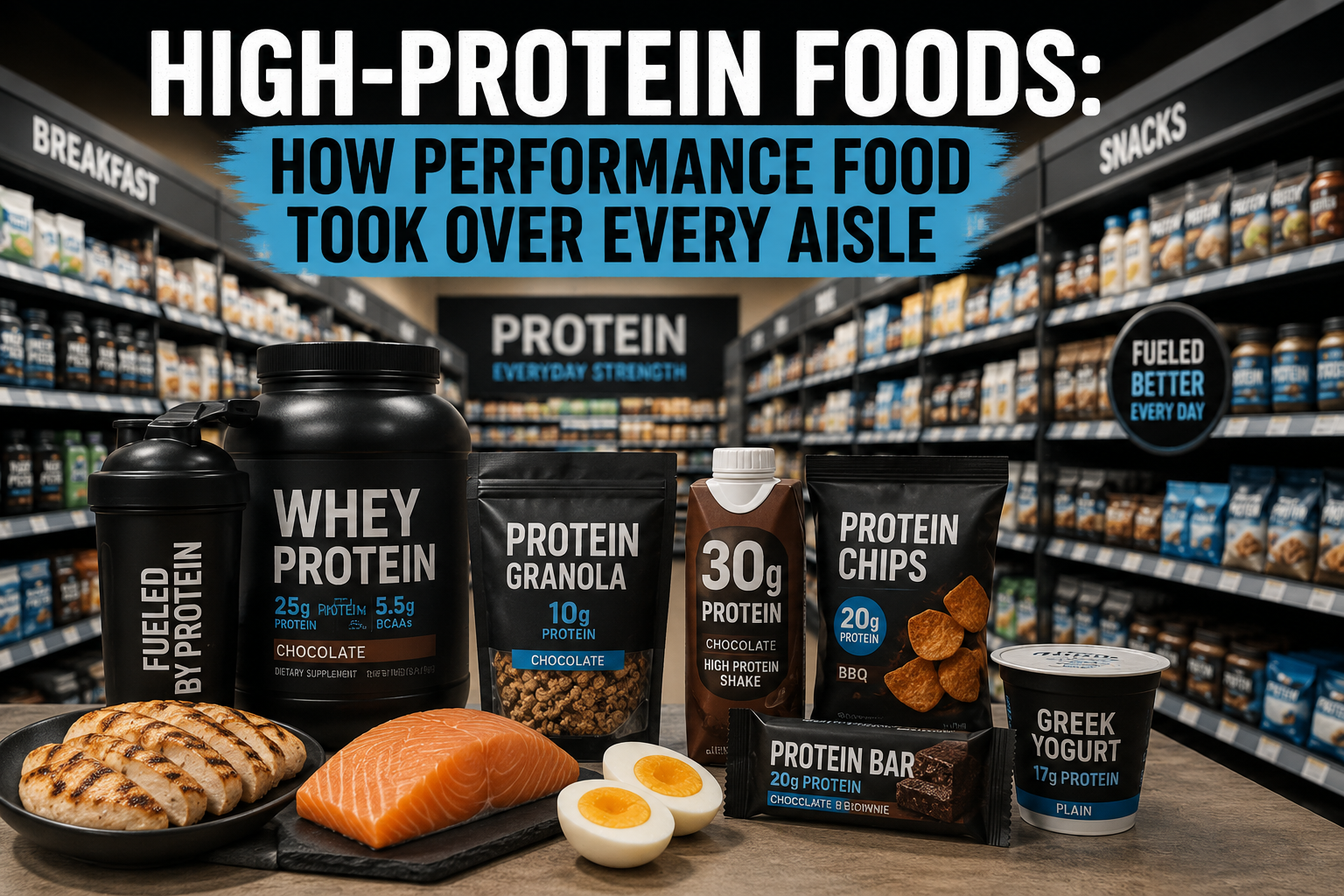
Walk down any grocery aisle today and you’ll notice something strange — and kind of wonderful. The chip rack now has 25 grams of protein per serving. The freezer section has ice cream that promises to build lean muscle. There’s protein-packed pasta, high-protein yogurt, protein cookies, protein puffs, and even protein coffee.
What happened? When exactly did your grocery store start looking like a supplement shop?
The answer is not a sudden shift — it’s been building for years. But in 2026, the high-protein food movement has officially exploded into the mainstream. It’s no longer about bodybuilders sipping chalky shakes in the gym parking lot. Today, protein is the hottest macro on the planet, and food brands are racing to put it in everything from breakfast cereal to dessert. Welcome to the performance food boom.
The Numbers Don’t Lie: This Is a Billion-Dollar Revolution
If you ever needed proof that the high-protein food trend is more than just a fad, look at the money. The global protein snacks market — which includes everything from protein chips and meat jerky to protein bars and cookies — was valued at $54.86 billion in 2025. By 2026, it had already climbed to $59.65 billion, and experts project it will more than double to $120.43 billion by 2034.
Let that sink in for a moment. We’re talking about a market that could grow by over $60 billion in less than a decade, simply because consumers want more protein in their snacks.
And that’s just snacks. The broader high-protein powders market — covering protein shakes, meal replacements, and supplement blends — stood at $28.86 billion in 2026 and is on track to reach $50.43 billion by 2035, growing at a steady compound annual growth rate of 6.4%.
Meanwhile, sales of protein supplements and meal replacements in the United States alone grew by double-digit unit and dollar terms year over year in 2025, generating $8.6 billion in protein supplement sales alone. That’s not a trend — that’s a transformation.
Why Protein? Why Now?
Here’s the thing: protein has always been important. Nutritionists have recommended it for decades. Gym culture has worshipped it for generations. So why is 2026 the year it’s finally dominating the entire grocery store?
The answer is a perfect storm of health awareness, lifestyle shifts, and smart marketing — all converging at once.
1. Protein is the anti-sugar.
People are tired of sugar crashes. They want snacks that actually fill them up, keep their energy steady, and don’t leave them reaching for something else 30 minutes later. Protein does exactly that. It promotes satiety — that feeling of being genuinely full — in a way that carbohydrate-heavy or empty-calorie snacks simply can’t match. Consumers have figured this out, and they’re voting with their wallets.
2. The fitness mindset went mainstream.
Going to the gym used to be a niche hobby. Now it’s a cultural identity. Millions of people who’ve never lifted a weight in their lives are tracking their macros, downloading workout apps, and thinking seriously about what they eat before and after exercise. This new health-conscious consumer doesn’t just want supplements — they want their everyday food to work harder for them.
3. Post-pandemic health consciousness never went away.
The pandemic made people genuinely care about their health in a way that previous generations didn’t. Immune function, muscle health, weight management, longevity — all of these conversations pushed protein squarely into the spotlight. People started reading nutrition labels. They started caring about what was actually in their food.
4. Social media made protein aspirational.
TikTok and Instagram turned protein-rich recipes into viral content. Creators began showing millions of followers how to make high-protein overnight oats, protein pancakes, and high-protein ice cream at home. The content spread — and so did the demand. Brands noticed, and they responded with a wave of protein-fortified products unlike anything the food industry had seen before.
From the Gym to the Grocery Aisle: How It All Changed
Not long ago, if you wanted a high-protein snack, your options were limited: a chalky protein bar, a dry tub of whey powder, or maybe some plain chicken breast. The idea of a protein-rich potato chip or protein-infused ice cream would have seemed absurd.
Today, it’s reality — and it’s everywhere.
Protein Chips have become one of the fastest-growing product categories in the entire snack industry. Brands like Quest Nutrition, which first made its name in the protein bar space, expanded aggressively into savory snacks — protein chips, crackers, and puffs — that deliver the crunch of your favorite junk food with 20+ grams of protein per bag. Search interest for protein chips has grown 31% over the past year, with 321,000 monthly searches and climbing.
Half of global consumers now say that “high in protein” is an important attribute when they’re choosing a snack. That’s not a niche preference — that’s the new normal.
Protein Ice Cream is another category that would have seemed like science fiction five years ago. Yet here we are, with protein ice cream recording 40% search growth and 219,000 monthly searches. Brands have cracked the formula: ultra-low sugar, high protein content (often 20+ grams per pint), and flavors that genuinely compete with traditional ice cream. For fitness-conscious consumers who still want dessert, this is the perfect answer.
High-Protein Yogurt is up 46% in search interest, with 153,000 monthly searches. Greek yogurt started this trend years ago, but the market has exploded into Icelandic skyr, protein-fortified kefir, and cottage cheese products that pack 20 to 30 grams of protein per serving.
Protein Cereals, Cookies, Pasta, and More — the fortification of everyday foods is accelerating rapidly. Cereal brands, bakeries, pasta companies, and even snack pretzel makers are now slapping 15g+ protein claims on their packaging, knowing that consumers are actively scanning for them. Protein-rich shots and sodas are among the emerging formats drawing significant consumer interest, with ready-to-drink protein beverages growing at a 13% compound annual growth rate over the past two years.
Who Is Actually Buying All This Protein?
This is where it gets interesting. The performance food boom is not being driven by elite athletes or hardcore bodybuilders. It’s being driven by everyday people — and the demographic is remarkably broad.
Office workers are grabbing protein bars as a between-meetings snack because they’ve learned it keeps them sharper in the afternoon than a bag of chips ever did.
Parents are adding high-protein options to their kids’ lunchboxes because they want meals that fuel rather than crash.
College students are building their diets around protein because campus fitness culture is at an all-time high.
Older adults are turning to high-protein diets because research has consistently shown that maintaining adequate protein intake is one of the most effective tools for preserving muscle mass as we age — and avoiding the weakness and frailty that can come with getting older.
Women are a massive and often underserved part of this market. The conversation around protein used to be dominated by men chasing muscle size. That’s changed. Women now make up a huge portion of the performance nutrition market, driven by interest in lean muscle, functional fitness, weight management, and long-term health.
The motivation varies by group — some focus on convenience, some on hitting daily protein targets, some on weight management, some on post-workout muscle recovery. But the common thread is simple: they want food that works. Fewer ingredients, more satiety, real nutritional value, and — critically — great taste.
The Taste Problem: How Brands Finally Cracked It
Here’s a truth that the protein food industry spent years painfully learning: nobody wants to eat something just because it’s healthy. If it doesn’t taste good, consumers won’t buy it twice, no matter how impressive the nutrition label.
Early protein bars were notorious for being dense, chalky, and overwhelmingly sweet. Early protein chips had the texture of cardboard. The first wave of protein products succeeded in delivering the macro but completely failed to deliver the experience.
That changed around 2023–2024 and has accelerated dramatically through 2026. Food scientists, flavor engineers, and culinary-trained product developers began solving the taste problem with genuinely impressive results. The industry trend data reflects this: “pleasure” as a driver of high-protein food purchases reached 63.8% in key markets — a 3-point jump year over year — meaning consumers are increasingly buying protein-rich products because they actually enjoy eating them, not just as a health obligation.
Quest’s protein chips genuinely crunch. Protein ice cream genuinely satisfies a sweet craving. High-protein cookies have achieved the kind of chewy, indulgent texture that makes people forget they’re eating something that’s actually good for them.
This is the moment the performance food market was waiting for: the point where healthy and delicious stopped being opposites.
Protein Timing: The Science That Supercharged the Trend
One of the concepts that has crossed over from sports nutrition into mainstream food culture is protein timing — the idea that when you eat protein matters, not just how much you eat overall.
The International Society of Sports Nutrition recommends 1.6 to 2.2 grams of protein per kilogram of body weight per day for active adults — and recommends spreading that intake across multiple meals and snacks rather than loading it all at once. This finding has had a profound effect on consumer behavior.
If you need to hit a protein target across the full day — not just at dinner — then you need protein-rich options at breakfast, at your mid-morning snack, at lunch, after your workout, and maybe even in your dessert. That’s exactly the market that performance food brands have built their entire product strategy around.
High-protein breakfasts (skyr, protein pancake mixes, fortified cereals), portable protein snacks for mid-morning and afternoon, high-protein bars for post-workout recovery, and protein-enriched desserts for the evening — brands have mapped every eating occasion and created a protein product for each one.
The Clean Label Shift: Protein Meets Transparency
Not all protein is created equal, and increasingly, consumers know it. A significant portion of the market — particularly older millennials and Gen X — is pushing back against the idea of protein-fortified ultra-processed foods. They want protein, but they want it from sources they can recognize and trust.
This is driving the “clean-label protein” movement: products that deliver high protein content from natural, whole-food sources with minimal additives, artificial sweeteners, or synthetic fillers. Research shows that 40% of consumers prioritize natural and whole-food protein sources when they’re shopping, making clean-label positioning a genuine market differentiator.
Brands are responding. Meat snacks made from simple ingredients — real beef, minimal seasoning, no preservatives — have surged in popularity. Nut-based protein bars featuring whole almonds, cashews, and dates are outperforming artificially sweetened alternatives in multiple markets. Cottage cheese, eggs, canned fish, and legumes are being repositioned as the original high-protein performance foods.
The parallel track of “functional but clean” is shaping the next generation of performance food — products that hit serious protein numbers without requiring a chemistry degree to understand the ingredient list.
Plant-Based Protein: Holding Its Ground
While animal-based proteins still dominate — accounting for roughly 55% of the market in 2025 — plant-based protein options are growing steadily and carving out a meaningful segment of the performance food boom.
Chickpea chips, lentil puffs, black bean snacks, and pea-protein bars are finding real traction among vegan, vegetarian, and flexitarian consumers. Brands like Hippeas and Bada Bean Bada Boom have demonstrated that plant-forward protein snacks can compete on taste, texture, and nutritional value.
The plant-based protein snack segment is expected to record the highest growth rate of any segment in the protein snacks category through 2034, reflecting a growing consumer base that wants functional nutrition without animal products.
The GLP-1 Effect: An Unexpected Catalyst
No discussion of the 2026 performance food market would be complete without mentioning GLP-1 medications — the class of weight-loss drugs that includes brands like Ozempic and Wegovy. These medications have created an unexpected and significant tailwind for the high-protein food market.
GLP-1 users eat less overall — that’s the point. But because they’re consuming smaller quantities of food, every bite has to count nutritionally. Doctors and dietitians working with GLP-1 patients consistently emphasize the importance of prioritizing protein intake to prevent muscle loss during weight reduction. This has sent a new wave of consumers into the performance food aisle, specifically looking for nutrient-dense, high-protein options in smaller portion sizes.
Food brands have noticed. Nutrient-dense, protein-rich products in controlled serving sizes are emerging as a direct response to the dietary needs of GLP-1 users — a demographic that is growing rapidly and spending significantly on food that supports their health goals.
What This Means for the Future of Food
The performance food boom isn’t a trend that’s going to peak and fade. The underlying drivers — consumer health consciousness, mainstream fitness culture, scientific understanding of protein’s role in longevity and weight management, and the sheer taste improvement in protein-enriched products — are structural, not cyclical.
We’re heading toward a future where the line between “health food” and “regular food” continues to blur. The grocery store of 2028 may not have a separate “health food” section, because the entire store will have been reformulated to meet consumer demand for functional nutrition. Protein will be the leading edge of that transformation.
For investors, entrepreneurs, and food brands, the message is clear: the performance food market is far from saturated. Global markets — particularly in Asia-Pacific, which is forecast to expand at a 7.56% CAGR through 2031 — represent enormous growth opportunity for brands that can deliver the holy trinity of modern protein food: great taste, clean ingredients, and serious nutritional value.
For consumers, the message is even simpler: the best time to eat more protein has never been easier. It’s in your chips. It’s in your ice cream. It’s in your cereal bowl in the morning and your dessert at night.
Performance food has officially taken over the grocery aisle — and honestly, it’s about time.
Key Takeaways
- The global protein snacks market is worth $59.65 billion in 2026 and projected to reach $120.43 billion by 2034.
- Protein chips, protein ice cream, and high-protein yogurt are among the fastest-growing product categories in food retail.
- Half of global consumers say “high in protein” is an important attribute when choosing a snack.
- The market has expanded far beyond athletes — office workers, parents, students, and older adults are all driving growth.
- Taste improvement has been the critical breakthrough that turned performance food from a niche category into a mainstream phenomenon.
- Clean-label protein — from natural, recognizable sources — is the next frontier in the high-protein food evolution.
- GLP-1 medication users represent a new and growing consumer segment with specific protein-focused nutritional needs.
This article was published on TheForbesLine.com. For more coverage of food, fitness, health, and business trends, explore our Health and Business sections