For more than two decades, millions of Americans on Medicare watched from the sidelines as newer, more effective weight loss medications hit the market — and then watched the price tags put those drugs completely out of reach. Wegovy. Zepbound. Ozempic. The names became household words. The monthly cost — often $1,000 or more without coverage — stayed firmly in the category of “not for people on a fixed income.”
That is about to change.
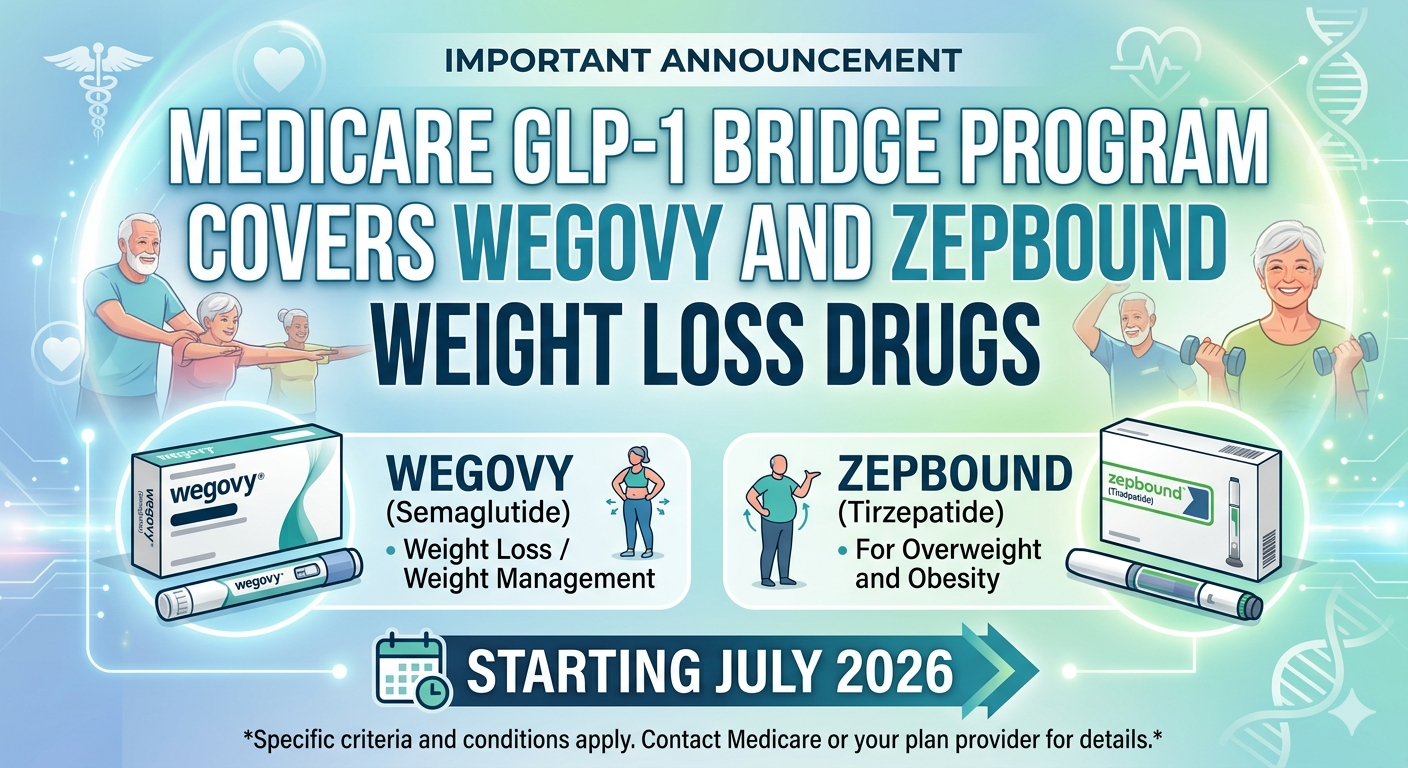
Starting July 1, 2026, Medicare will cover prescription weight loss drugs for the first time in its history. It’s not a rumor, it’s not a proposal, and it’s not buried in fine print. The Centers for Medicare & Medicaid Services (CMS) has officially announced the Medicare GLP-1 Bridge — a landmark program that gives eligible Medicare beneficiaries access to FDA-approved weight loss medications like Wegovy and Zepbound for just $50 a month.
If you’re on Medicare, know someone who is, or care about what this means for American healthcare, this is a story worth understanding in full.
The 20-Year Wait Is Finally Over
Here’s a piece of history that most people don’t know: Congress banned Medicare from covering weight loss drugs back in 2003, when it created Medicare Part D — the prescription drug benefit program. That wasn’t an oversight. It was a deliberate policy decision, made at a time when the available weight loss medications weren’t particularly effective and concerns about misuse ran high.
More than two decades later, the pharmaceutical landscape looks completely different. GLP-1 receptor agonists — the drug class that includes semaglutide (Wegovy, Ozempic) and tirzepatide (Zepbound, Mounjaro) — have demonstrated weight loss results that earlier generations of obesity medications never came close to achieving. Clinical trials showed patients losing 15% to 20% or more of their body weight. Cardiovascular outcomes improved. Blood pressure dropped. Sleep apnea resolved. The science was no longer marginal — it was compelling.
And yet, Medicare’s 2003 ban remained in effect — until now.
Starting July 1, 2026, Medicare will cover Wegovy and Zepbound for weight loss at a flat $50 per month copay through a new temporary program called the Medicare GLP-1 Bridge. This is the first time Medicare has ever covered prescription medications specifically for obesity, after a federal ban on that coverage that lasted more than 20 years.
What Is the Medicare GLP-1 Bridge Program?
The Medicare GLP-1 Bridge is a federal demonstration program created and managed directly by the Centers for Medicare & Medicaid Services. It’s not administered through your individual Part D drug plan — it operates as a separate, parallel pathway that CMS manages centrally.
The initiative will run from July 1, 2026, through December 31, 2027. It’s designed to “bridge” the gap before a longer-term program that might — or might not — begin in 2028.
The program will operate outside the Medicare Part D benefit and will utilize a central processor to handle prior authorizations, claims, and payments. This is an important technical detail: your insurance plan doesn’t need to do anything special. CMS runs this directly. Your doctor submits the prior authorization request to the central processor, not to your Part D plan.
The Medicare GLP-1 Bridge will be available nationwide across all states and territories. There are no geographic restrictions — whether you’re in rural Texas or downtown New York City, if you meet the eligibility criteria, you can access this program.
Which Weight Loss Drugs Are Covered?
Not every GLP-1 medication is included in the Bridge program. CMS has specified exactly which drugs qualify, and it’s important to know the distinction — especially if you’re currently taking a GLP-1 for diabetes rather than for weight loss.
The Bridge program covers Foundayo®, Wegovy® (injection and tablets), and Zepbound® (KwikPen®). Eligible beneficiaries will only pay a $50 copayment for each 30-day supply.
A few important clarifications:
Ozempic and Mounjaro are NOT included in the Bridge. These medications use the same active ingredients as Wegovy and Zepbound — semaglutide and tirzepatide respectively — but they’re FDA-approved for type 2 diabetes management, not specifically for weight loss. Medicare Part D already covers Ozempic and Mounjaro for diabetes. The GLP-1 Bridge does not change that.
Foundayo is a newer oral daily pill that received fast-track FDA approval and will compete with the pill form of Wegovy as an alternative to injections — an important option for patients who prefer not to self-inject.
CMS also says participating manufacturers will provide eligible drugs at a net price of $245 per monthly supply — meaning the federal government has negotiated a dramatically reduced price on your behalf, with the $50 copay being your portion of that.
Who Qualifies? The Eligibility Rules Explained
This is the question on everyone’s mind. The eligibility criteria are specific, so let’s walk through them clearly.
Basic requirements — you must:
- Be 18 years of age or older
- Be enrolled in Medicare with Part D drug coverage — either a standalone Prescription Drug Plan (PDP) or a Medicare Advantage plan that includes drug coverage
BMI-based eligibility — you qualify if:
Eligibility is based on BMI of 35 or more alone, or 27 or more plus other clinical criteria.
More specifically, if your BMI is 27 or higher and you have at least one of the following conditions, you qualify:
- Heart disease (including heart failure)
- High blood pressure (hypertension)
- Prediabetes or Type 2 diabetes
- Obstructive sleep apnea
- High cholesterol or dyslipidemia
- Certain other metabolic conditions
People with BMIs of 35 or higher automatically qualify. No additional health condition is required at that threshold.
Already on a GLP-1 for weight loss? You may still be eligible even if your BMI has changed since you started treatment. If you’re already on a GLP-1 for weight loss, you may qualify for the Bridge program. Your prescriber will need to attest that you met the clinical criteria when you first started the medication.
One important caveat on costs: Because the Bridge will operate outside the Part D benefit, the $50 copayment won’t count towards the Part D deductible or the $2,100 out-of-pocket spending cap. This means your Bridge copays are a separate expense — they don’t reduce your other Part D cost obligations.
Why This Matters: The Scale of America’s Obesity Problem
To understand why this policy shift is so significant, you have to look at the numbers.
More than 70% of adults in the United States are considered to have obesity or screen as overweight, which increases risks for numerous chronic diseases, such as type 2 diabetes, cardiovascular disease, obstructive sleep apnea, and other metabolic conditions.
Among Medicare recipients specifically — the 65-and-older population — obesity rates are particularly high, and the health consequences are more severe. Obese seniors face dramatically elevated risks of heart attack, stroke, type 2 diabetes, joint replacement surgery, and mobility limitations that erode independence and quality of life.
A previous KFF analysis estimated that close to 14 million Medicare beneficiaries had a diagnosis of overweight or obesity in 2020 — and that number has only grown since. Even if just a fraction of those individuals qualify under the specific Bridge eligibility criteria, we’re talking about millions of Americans gaining access to medications that have genuinely transformed lives.
The previous barrier was stark and simple: money. Even with discounts, current cash prices for GLP-1 weight loss drugs typically range from $149 to $699 per month. For seniors living on Social Security and fixed retirement income, that’s not an option. It was never an option. The Bridge program changes that arithmetic completely.
What Comes After the Bridge? The Road to 2028
The Medicare GLP-1 Bridge is explicitly designed as a temporary measure — a policy bridge (hence the name) while CMS works toward a more permanent solution. Understanding what comes next matters, because the future of this coverage is not yet guaranteed.
At the same time as launching the Bridge, CMS has delayed part of a longer-term program called the BALANCE Model. This program is still being evaluated as a future option for broader Medicare coverage of these medications.
The BALANCE Model — which stands for Better Approaches to Lifestyle and Nutrition for Comprehensive hEalth — was originally designed to launch in January 2027. Under BALANCE, CMS would negotiate prices directly with GLP-1 manufacturers on behalf of Part D plans and state Medicaid programs, creating a more sustainable, longer-term pathway for obesity drug coverage.
There is no clear path forward for GLP-1 coverage in Medicare after 2027 if the Medicare GLP-1 Bridge is not extended further and the BALANCE Model is not implemented. This sets up the possibility that Medicare beneficiaries could have coverage through the Bridge in 2026 and 2027 but then lose access in 2028 if the BALANCE Model or another coverage pathway is not implemented.
In plain terms: the coverage that starts July 1 is real and meaningful — but it’s not yet permanent. Advocates for seniors and obesity medicine specialists are watching closely to see whether the BALANCE Model gets implemented as planned or whether political and fiscal headwinds delay it further.
What About Medicaid?
The Medicare GLP-1 Bridge is specifically for Medicare beneficiaries, but Medicaid coverage is also evolving.
State Medicaid agencies can join the BALANCE model beginning in May 2026 through January 1, 2027. Under BALANCE, CMS negotiates lower prices with GLP-1 manufacturers on behalf of state Medicaid programs — but individual states must choose to opt in, meaning coverage will be uneven across the country depending on where you live.
For low-income Americans not yet on Medicare who rely on Medicaid for healthcare coverage, this patchwork approach means the fight for affordable weight loss medication coverage is still very much ongoing.
How to Access the Program: A Practical Guide
If you think you may qualify for the Medicare GLP-1 Bridge, here’s what to do:
Step 1: Confirm your Medicare coverage type. You need to be enrolled in a Medicare Part D plan — either a standalone Prescription Drug Plan or a Medicare Advantage plan with drug coverage. If you’re on Medicare Part A and B only (Original Medicare without drug coverage), you’ll need to add Part D to be eligible.
Step 2: Make an appointment with your doctor. Your prescribing physician will need to submit a prior authorization request to the Bridge program’s central processor — not to your insurance plan. Bring documentation of your BMI and any qualifying health conditions to your appointment.
Step 3: Your doctor submits the prior authorization. This goes directly to the CMS central processor. Coverage requires provider approval, prior authorization, and CMS eligibility rules. The process is designed to be separate from your normal Part D coverage, so your insurance company’s prior authorization rules do not apply here.
Step 4: Pick up your medication at the pharmacy. Once approved, you’ll pay the $50 monthly copay at the pharmacy. CMS also says coupons and discount programs cannot apply to Medicare GLP-1 Bridge claims — so don’t expect manufacturer discount cards to reduce your cost further.
Step 5: Know your timeline. The program runs through December 31, 2027. Stay informed about whether the BALANCE Model or another coverage pathway launches in 2028, so you’re not caught off guard if coverage status changes.
What the Experts Are Saying
The medical and patient advocacy community has greeted this announcement with cautious enthusiasm. The word “cautious” is important — the time-limited nature of the Bridge, its exclusion from the Part D out-of-pocket cap, and the uncertain future beyond 2027 are legitimate concerns.
As Novo Nordisk, the maker of Wegovy, put it: “Obesity is a serious, common chronic disease facing older Americans, and Wegovy® is the only weight management medicine proven to reduce the risk of heart attack, stroke, or cardiovascular death in patients who also have known heart disease.”
That cardiovascular distinction matters enormously for the Medicare population, which disproportionately carries both obesity and heart disease. The drugs available through the Bridge aren’t just about fitting into smaller jeans — they’re about reducing the risk of life-threatening cardiac events in a population that faces those risks every day.
Patient advocates at the Obesity Action Coalition have described the Bridge as “an important step forward” while noting that the true measure of success will be whether CMS can build a durable, long-term coverage pathway in the years to come.
The Bigger Picture: What This Means for American Healthcare
The Medicare GLP-1 Bridge is more than a drug coverage announcement. It’s a signal about where American healthcare policy is heading — and the tensions that will shape it for the next decade.
On one side: compelling clinical evidence that GLP-1 medications reduce not just weight but cardiovascular events, hospitalizations, and ultimately healthcare costs for the Medicare system. An obese senior who avoids a heart attack or joint replacement surgery saves the system far more than a monthly obesity drug prescription costs.
On the other side: genuine fiscal uncertainty. The cost to Medicare of covering obesity drugs under Part D has been estimated at between $25 billion and $35 billion over 10 years. At a time when Medicare’s long-term solvency is already a policy concern, adding a major new drug benefit — even one with compelling health economics — requires careful navigation.
The Bridge program is CMS’s attempt to thread that needle: provide meaningful access now, generate real-world evidence on utilization and outcomes, and build the fiscal and policy case for a sustainable long-term solution.
Whether it succeeds will depend on participation rates, health outcomes data, political will, and the ongoing negotiations between the federal government and pharmaceutical manufacturers.
For the millions of American seniors who’ve been waiting more than two decades for this moment, the policy debates matter — but right now, what matters most is this: starting July 1, 2026, help is finally available.
Key Takeaways
- July 1, 2026 — the Medicare GLP-1 Bridge launches, ending a 23-year ban on Medicare obesity drug coverage.
- Covered drugs: Wegovy (injection and pill), Zepbound (KwikPen), and Foundayo pill.
- Cost: $50 per month copay — compared to up to $1,000+ monthly cash prices.
- Eligibility: Medicare Part D enrollment required, plus BMI of 35+ OR BMI of 27+ with qualifying conditions (heart disease, prediabetes, hypertension, sleep apnea, and others).
- Duration: Program runs through December 31, 2027. Coverage beyond that date is not yet guaranteed.
- How to apply: Talk to your doctor — they submit prior authorization directly to CMS, not through your insurance plan.
- The $50 copay does not count toward your Part D out-of-pocket maximum — this is a separate cost.