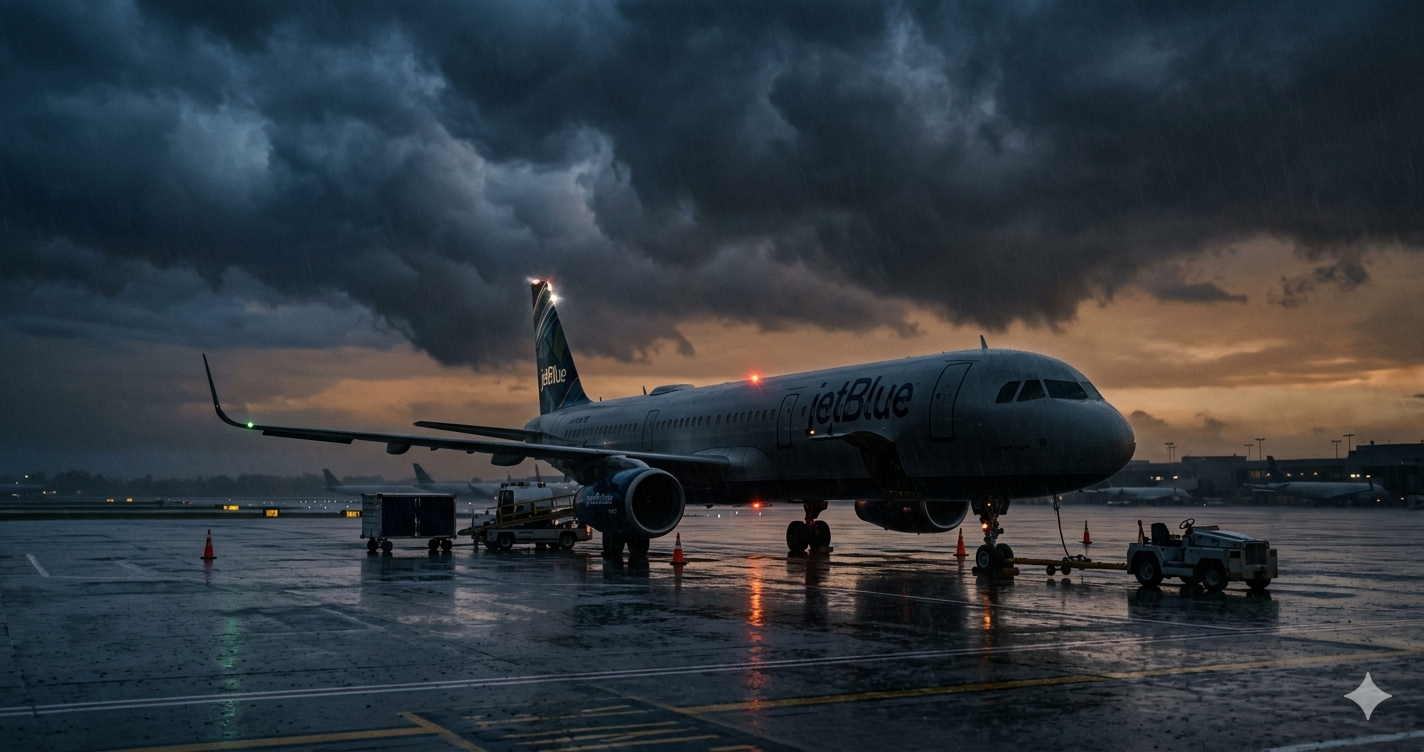
When the Founder of an Airline Warns It Might Go Bankrupt, Pay Attention
David Neeleman founded JetBlue Airways. He built it from scratch, grew it into one of America’s most recognizable airlines, and knows its inner workings better than almost anyone on the planet.
So when he stood up at a Breeze Airways pilot session in April 2026 and said — on the record, with his words recorded and circulated — “JetBlue is in a really tough spot. They really are,” the aviation world took notice.
Neeleman went further. Citing J.P. Morgan analysis showing that if jet fuel reaches $4.50 per gallon, JetBlue could lose $1.3 billion in 2026, he added: “That would probably put them, you know, into bankruptcy, I would assume.”
Jet fuel has already approached that level in 2026. Analysts at leading firms now put JetBlue’s probability of bankruptcy by 2027 at greater than 75%. JetBlue’s own stock has fallen by roughly two-thirds from its peak, trading at what analysts describe not as a valuation but as a distress signal.
So — is JetBlue actually going to go bankrupt? And what would it mean for passengers if it does?
The Numbers Behind the Warning
Let us look at what the financials actually show.
Debt: JetBlue carries approximately $5.3 billion in long-term debt against equity capitalization of just $3.2 billion — a debt-to-equity ratio of 6.31 that analysts describe as a clear red flag. A potential $1.3 billion loss in 2026 would push total debt toward $9 billion, creating what analysts call a liquidity trap.
Annual losses: JetBlue has now recorded annual losses for six consecutive years. The airline reported a net loss of $602 million for 2025 alone. Continued losses are rapidly depleting the financial cushion that separates the airline from a liquidity crisis.
Debt maturities: The timing of JetBlue’s debt repayment schedule adds pressure. The airline faces approximately $755 million in debt maturities during 2026, followed by $411 million in 2027 and $516 million in 2028. While not yet catastrophic, these maturities arriving during a period of heavy losses and high fuel costs create significant strain.
Credit rating: JetBlue has been downgraded to CCC+ status — a distressed credit level. This makes refinancing existing debt significantly more expensive, as lenders demand higher interest rates and stricter conditions from financially distressed borrowers.
Labor costs: Labor negotiations in 2026 resulted in wage agreements that boosted crew costs by 26% through 2029. JetBlue pilot contracts now match those offered by major legacy carriers — eliminating one of the key cost advantages that budget airlines historically relied upon to compete.
Current liquidity: The one piece of relatively good news is that JetBlue is not yet facing an immediate liquidity crisis. The airline finished Q1 2026 with approximately $2.4 billion in available liquidity and access to a further $600 million revolving credit line. This buys time — but time alone does not solve structural financial problems.
What Would Push JetBlue Into Bankruptcy?
JetBlue is not going bankrupt today. But the path to bankruptcy becomes increasingly clear if any of the following happen:
Fuel prices rise further. Neeleman’s warning was based on $4.50 per gallon fuel. If Middle East tensions escalate and prices push toward or beyond that level, J.P. Morgan’s projected $1.3 billion loss scenario becomes reality. A loss of that magnitude would rapidly drain JetBlue’s liquidity buffer.
Revenue weakens. JetBlue generates approximately $10.8 billion in annual revenue but with profit margins below 2%. Any meaningful decline in demand — from an economic slowdown, reduced consumer confidence, or the disappearance of budget travel competitors that previously drove passengers to book their own routes as alternatives — would tip the balance.
Debt refinancing becomes impossible. With a CCC+ credit rating, JetBlue’s ability to refinance maturing debt at reasonable terms is already compromised. If credit markets tighten further or the airline’s financial situation deteriorates, refinancing could become prohibitively expensive or unavailable.
No acquisition materializes. Some analysts believe JetBlue’s best realistic outcome is acquisition by a larger carrier. However, Neeleman himself expressed doubt about this path, noting that United is reportedly wary of taking on JetBlue’s debt, while Southwest and Alaska Airlines have shown little interest.
How Does JetBlue Compare to the Airlines That Already Collapsed?
It is worth being precise about the comparison. JetBlue is not Spirit Airlines.
Spirit had accumulated over $3.3 billion in debt by mid-2024, had reported losses for years, had a business model dependent entirely on filling cheap seats, and by April 2026 faced a fuel cost burden that literally exceeded its cash reserves. Spirit’s collapse was the result of structural impossibility — the math simply did not work.
JetBlue is in a different but still serious position. It has more revenue diversity than Spirit — it operates longer routes, has a more established brand, and serves more business travelers than ultra-low-cost carriers typically do. Its TrueBlue loyalty program has real value. Its $2.4 billion liquidity position gives it runway that Spirit never had in its final months.
But the direction of travel is concerning. Six consecutive years of losses. Rising debt. Higher labor costs. A credit rating in distress territory. And a fuel environment that could push it into a $1.3 billion annual loss.
The difference between JetBlue and Spirit is a matter of degree, not kind. Both are being squeezed by the same forces. JetBlue just has more cushion — for now.
What About Frontier Airlines?
Frontier Airlines is the other budget carrier that analysts are watching closely. Aviation experts estimate Frontier’s bankruptcy risk at around 45 to 50% — lower than JetBlue’s projected probability but still elevated.
Frontier faces manageable near-term debt maturities — approximately $303 million in 2026 and $63 million in 2027. The bigger pressure is aircraft lease payments of around $800 million per year and significant aircraft purchase commitments of $1.4 billion in 2026 and $2.1 billion in 2027.
The airline is already returning aircraft and deferring future deliveries — moves that suggest it is actively managing its exposure but that also signal financial strain. Like JetBlue, Frontier is not facing an immediate crisis, but the conditions that would push it there are present.
What Should JetBlue Passengers and Loyalty Members Do?
Given the uncertainty, passengers and loyalty program members who use JetBlue regularly should take some practical steps.
If you hold TrueBlue points: Redeem them for flights rather than letting balances accumulate. A flight redemption today has guaranteed value. A balance that exists if the airline faces restructuring may not. If JetBlue enters Chapter 11 restructuring rather than liquidation, the loyalty program would likely continue — but it is not guaranteed.
If you have future flights booked: Pay by credit card so you have chargeback rights if flights are canceled. Consider travel insurance that specifically covers airline insolvency.
If you are planning to book: This is a personal risk calculation. JetBlue is not in imminent danger of shutting down tomorrow. But the elevated risk is real and documented. If alternative carriers serve your route at comparable prices, that option reduces your exposure.
Do not panic — but do not ignore the signals either. The purpose of this analysis is to help you make informed decisions, not to create unnecessary alarm. JetBlue has real assets, real liquidity, and a genuine brand. But the same early warning signs that appeared in Spirit’s story are present in JetBlue’s current situation.
The Broader Lesson for 2026
The aviation industry is in a period of genuine financial stress. The full list of airlines that have already collapsed in 2026 is long and growing. The jet fuel crisis that drove many of those collapses has not resolved.
JetBlue is not the next Spirit — at least not yet. But it is operating in the same environment, facing the same pressures, and carrying a level of financial risk that deserves serious attention from passengers, loyalty program members, and investors alike.
Aviation analysts who put the bankruptcy probability at 75% by 2027 are not predicting certainty. They are saying the conditions are in place, and the outcome will depend on factors — fuel prices, demand trends, potential acquisitions — that remain genuinely uncertain.
Watch this space.
Understand the full crisis: Why Are So Many Low-Cost Airlines Collapsing in 2026?
The fuel crisis explained: The 2026 Jet Fuel Crisis